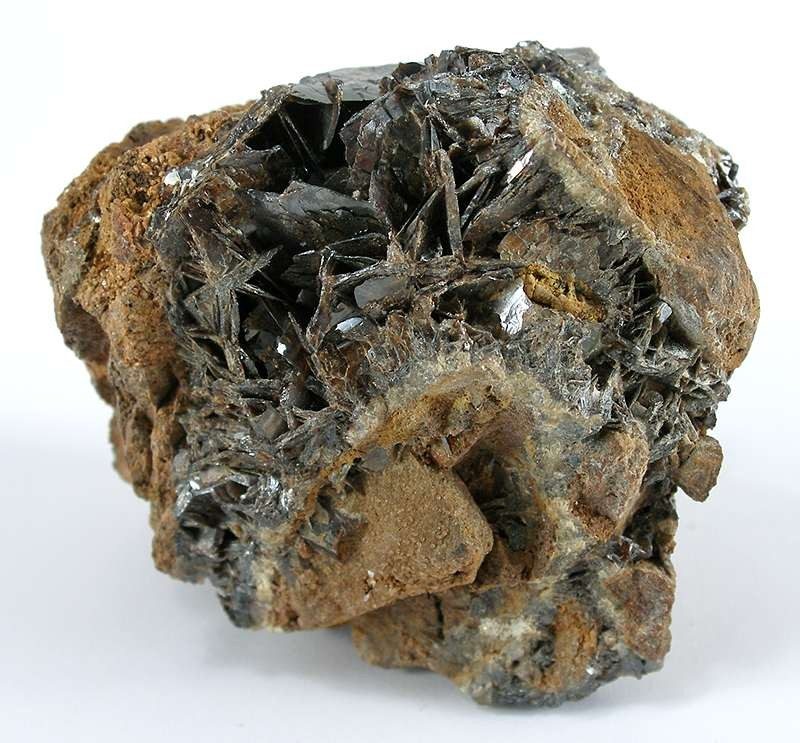
Nadorite Locality: Djebel Nador, Constantine Province , Algeria ( Locality at mindat.org ) Size: 4.1 x 3.8 x 3.2 cm. This is an extremely rich specimen of nadorite crystals from the type and best locality for the species, with color and metallic lustre. The crystals reach 1 cm in size and although many are broken or show portions, also there are many good crystals mixed in and the overall richness is significant. I am told that most of these were found during the French expeditionary times of the late 1800s and early 1900s, by the French colonial geological exploratory bureau BRGM (and have seen some such labels turn up on the market with nadorites, time to time, which confirms this). TYPE LOCALITY and the only locality for superb larger crystals of this species. — Photo: Robert M. Lavinsky · CC BY-SA 3.0
Nadorite
A brown-to-yellow lead antimonate-chloride mineral crystallizing in the orthorhombic system.
Intro adapted from Wikipedia (CC BY-SA).
Nadorite is an IMA-recognized mineral species in the halide class, with the chemical formula PbSb³⁺O₂Cl.
It crystallizes in the orthorhombic crystal system (space group Cmcm). It is a member of the Nadorite structural group.
Key properties: Mohs hardness 3.5–4; specific gravity 7.02; Yellow to yellowish white streak; Resinous to adamantine luster; optically biaxial.
IMA symbol Nad, grandfathered status — known before the IMA’s founding, named in 1870.
Occurs as an alteration product of other antimony-bearing minerals in hydrothermal mineral deposits.
It is found associated with Jamesonite, galena, sphalerite, bindheimite, sénarmontite, valentinite, anglesite, cerussite, smithsonite, mimetite.
The name refers to its original occurrence at Djebel Nador, Algeria.