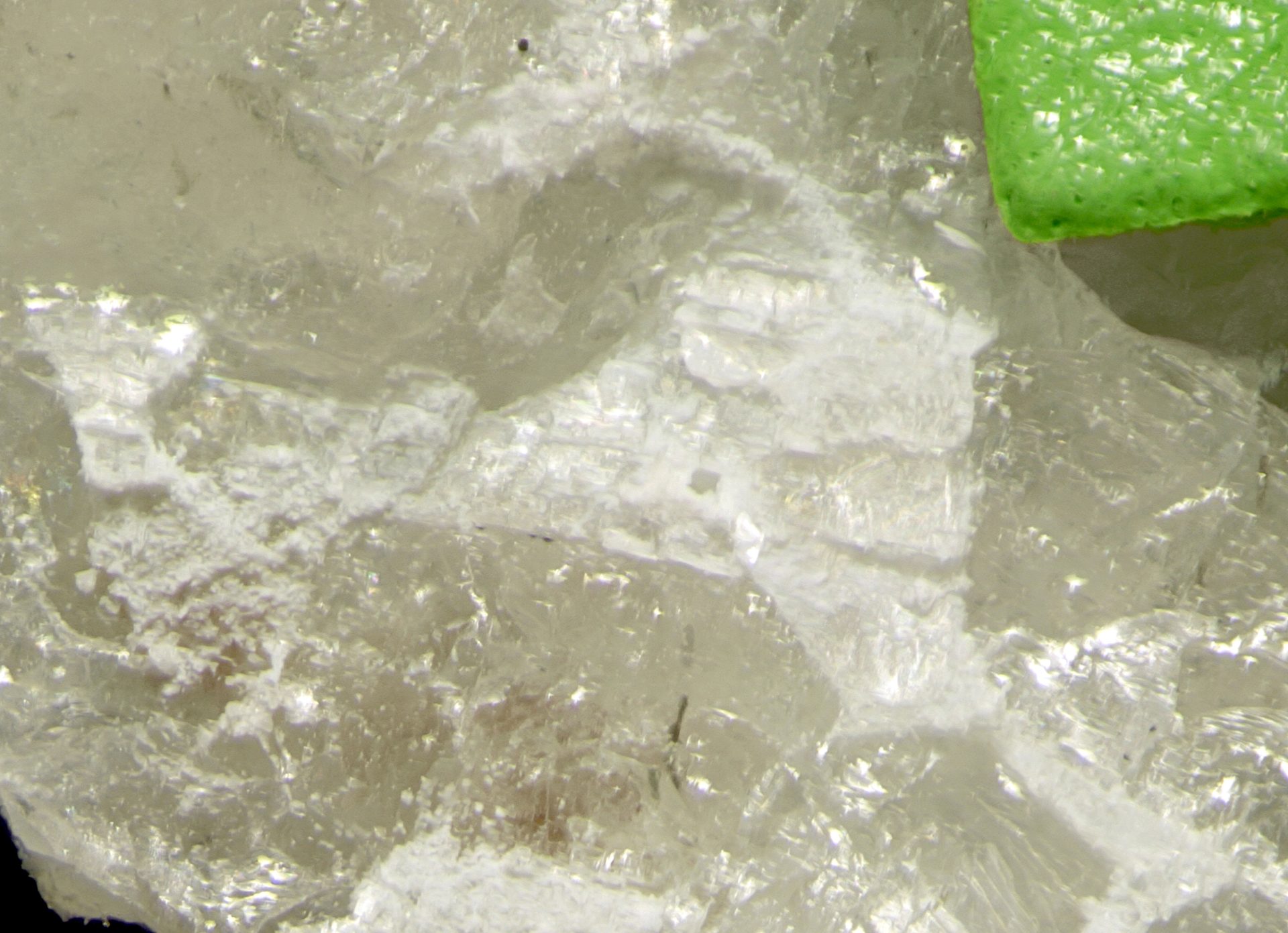
Gift from Tony Steede – thanks Tony! Modris Baum coll. The natrosilite consists of the reflective laths/plates in the center. I used the reflections to make the stuff visible.. In reality the laths are colorless and more or less transparent. Head-on, without reflections, the laths are almost impossible to spot – which explains why I left the green arrow on for the photo. Small as the specimen is, finding the natrosilite again without the help of an arrow seemed too iffy. So how did anybody spot this in the first place? No doubt the find had larger segregations of natrosilite which were more obvious. Modified by CombineZP. From: Poudrette quarry, Mont Saint-Hilaire, La Vallée-du-Richelieu RCM, Montérégie, Québec, Canada — Photo: Modris Baum · CC0
Natrosilite
Natrosilite is an IMA-recognized mineral species in the silicate class, with the chemical formula Na₂Si₂O₅.
It crystallizes in the monoclinic crystal system (space group P2_1/a).
Key properties: specific gravity 2.48; Pearly luster; optically biaxial.
IMA symbol Ns, IMA status: approved, named in 1974.
Found in pegmatites in nepheline syenites in differentiated alkalic massifs (Kola Peninsula, Russia); in sodalite xenoliths in association with an intrusive alkalic gabbro-syenite complex (Mont Saint-Hilaire, Canada).
It is found associated with Microcline, analcime, natrolite, lomonosovite, ussingite, vuonnemite (Lovozero massif, Russia); aenigmatite, aegirine, sodalite, cancrinite.
The name refers to sodium, NATRium, and SILicon in the composition.