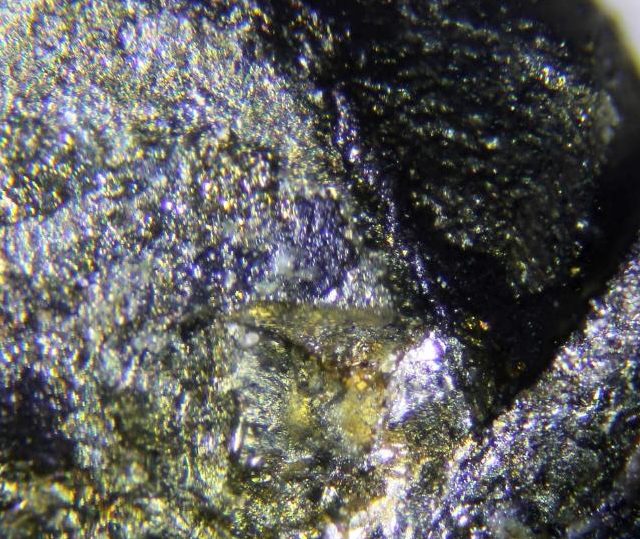
Black microinclusions of the extremely rare vanadium-tin mineral nekrasovite from the famous Bisbee mine in Arizona (Bisbee, Warren District, Mule Mountains, Cochise County, Arizona, United States of America), in a matrix of pyrite. Ex Vandenbroucke Museum collection from Waregem, Belgium. — Photo: David Hospital · CC BY 4.0
Nekrasovite
A rare isometric copper-vanadium sulfosalt occurring as small grains in ore aggregates.
Intro adapted from Wikipedia (CC BY-SA).
Nekrasovite is an IMA-recognized mineral species in the sulfide class, with the chemical formula Cu₁₃VSn₃S₁₆.
It crystallizes in the cubic crystal system (space group P-43n). It is a member of the Sphalerite, Germanite structural group.
Key properties: specific gravity 4.62.
IMA symbol Nek, IMA status: approved, named in 1983.
Found in ore aggregates within propylitic andesites and dacites (Khayragatsch deposit, Uzbekistan).
It is found associated with Tetrahedrite–tennantite, luzonite–famatinite, pyrite, mawsonite, chalcopyrite, emplectite, laitakarite, bismuth, calcite, quartz, barite (Khayragatsch deposit.
The mineral was named to honor Ivan Yakovlevich Nekrasov (1929–), Russian mineralogist, Institute of Experimental Mineralogy, Moscow, Russia.