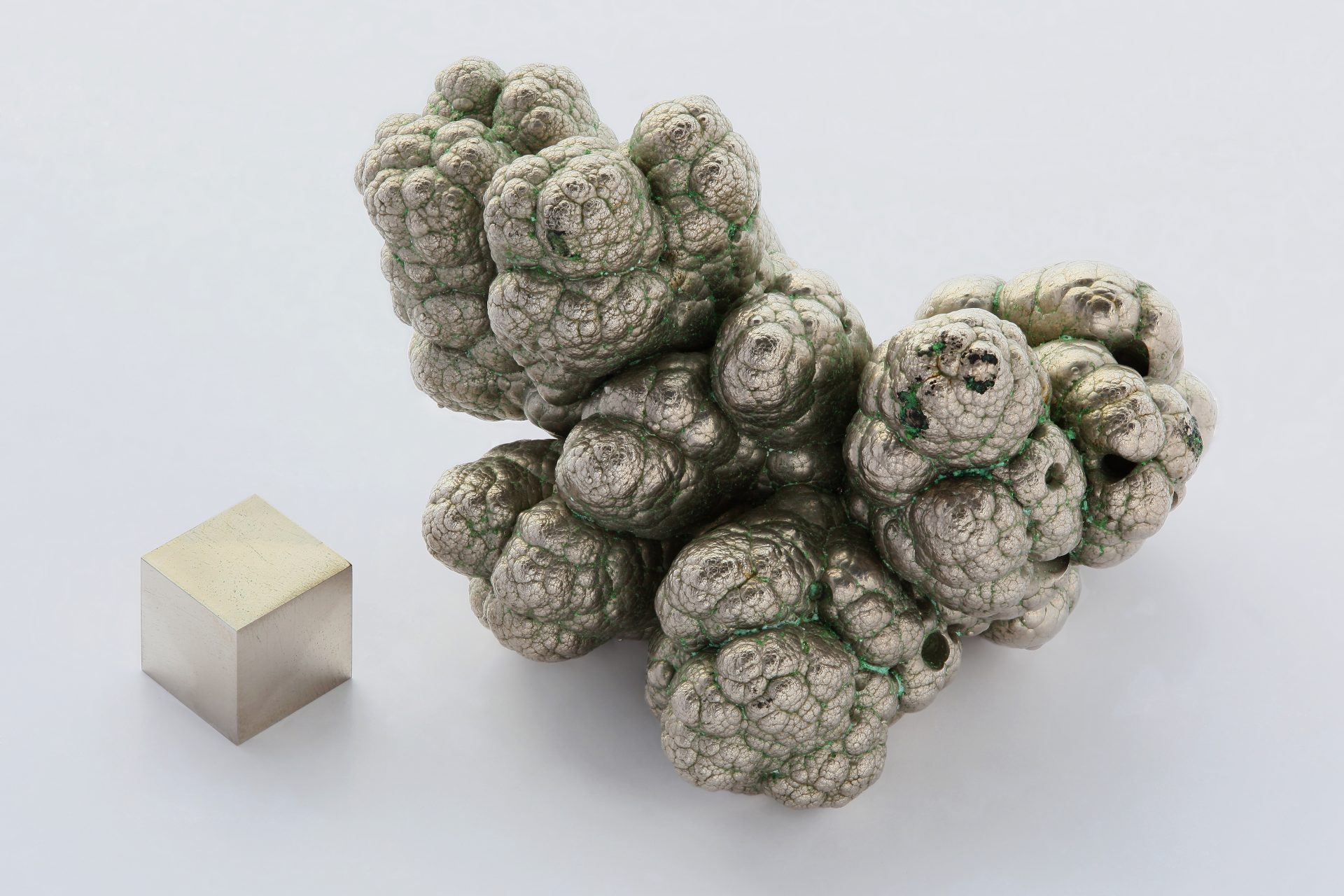
Electrolytically refined pure (99.9 %) nickel nodules, and a high purity (99.99 % = 4N) 1 cm 3 nickel cube for comparison. Crystallized nickel-electrolyte salts (green) can be seen in the pores of the nodules. — Photo: Alchemist-hp ( talk ) ( www.pse-mendelejew.de ) · FAL
Nickel
A hard, silvery transition metal (symbol Ni, atomic number 28) — essential to stainless steel, coins and rechargeable batteries; rare as a native element.
Intro adapted from Wikipedia (CC BY-SA).
Nickel is an IMA-recognized mineral species in the native element class, with the chemical formula Ni.
It crystallizes in the cubic crystal system (space group Fm3m). It is a member of the Copper structural group.
Key properties: Mohs hardness 4.5; specific gravity 8.9; gray streak; Metallic. R: n.d luster.
IMA symbol Ni, IMA status: approved, named in 1966.
Found in serpentinized ultramafic rocks as a result of low-temperature hydrothermal activity.
It is found associated with Heazlewoodite, pyrite, pyrrhotite, pentlandite, godlevskite, orcelite, millerite, nickel, copper, chalcopyrite, chalcocite, galena.
The name comes from the German nickel, demon, from a contraction of kupfernickel, or Devil’s copper, as the mineral was believed to contain copper but yielded none.