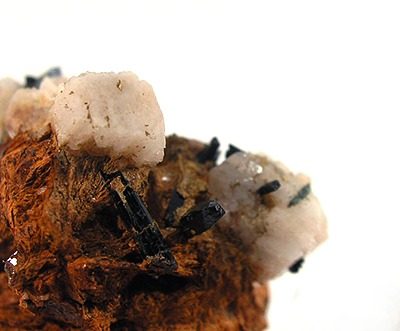
Niobophyllite Locality: Mt Malosa, Zomba District , Malawi ( Locality at mindat.org ) Size: thumbnail, 2.8 x 2 x 1.5 cm Niobophyllite with Feldspar, Aegerine I have followed, or so I thought, the new finds out of Mt Maloso for the past 7-8 years pretty well. In that time, I have had lots of aegerine and arfvedsonite, zircon, parisite, etc etc....but I had never seen one of these and in fact I'd never even heard of the species before now and had to go look it up: it is a titanium and niobium-containing fluorosilicate, nicely complex and interesting. It was only recently reported (Lapis, 2003) from this new locality for the species. I am told that these are the best, compared to previous occurences. This piece features tightly packed, bladed crystals of a rusty orange color, accented by feldspar and aegerine. It is quite non-ugly in person, surprisingly enough. 2.8 x 2 x 1.5 cm — Photo: Robert M. Lavinsky · CC BY-SA 3.0
Niobophyllite
Niobophyllite is an IMA-recognized mineral species in the silicate class, with the chemical formula K₂NaFe²⁺₇(Nb,Ti)₂(Si₄O₁₂)₂O₂(OH)₄(O,F).
It crystallizes in the triclinic crystal system (space group P-1). It is a member of the Astrophyllite-Astrophyllite structural group.
Key properties: specific gravity 3.42; optically biaxial.
IMA symbol Nbp, IMA status: approved, named in 1964.
Occurs as discontinuous seams and polycrystalline aggregates within a paragneiss intruded by an alkalic syenite (Seal Lake, Canada).
It is found associated with Albite, arfvedsonite, \aegirine-augite, " barylite, eudidymite, neptunite, manganoan pectolite, pyrochlore, joaquinite, sphalerite, galena (Seal Lake, Canada).
The name refers to its niobium content and the Greek word phyllite, meaning leaf, in allusion to its micaceous habit.