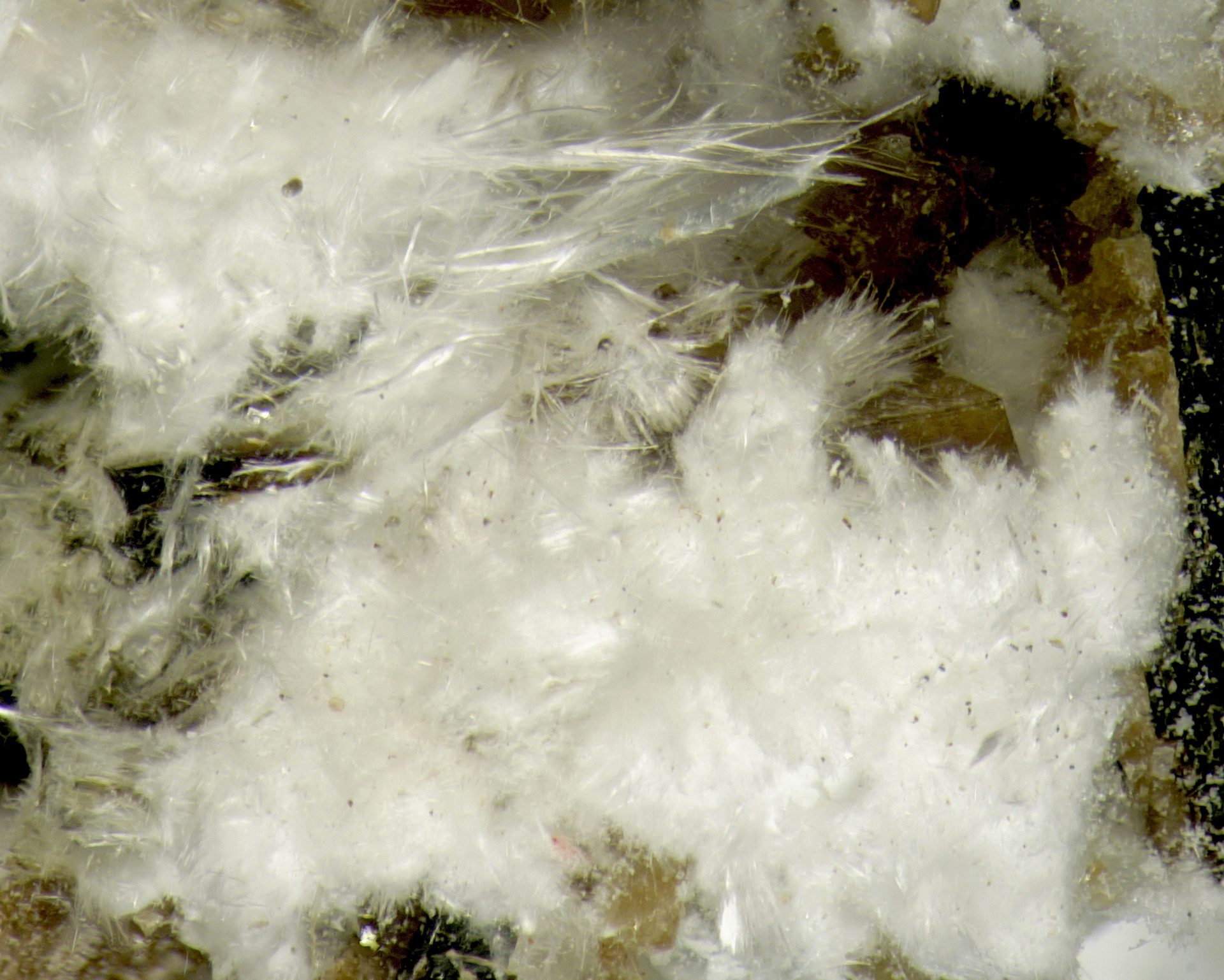
Niveolanite Locality: Poudrette quarry (De-Mix quarry; Demix quarry; Uni-Mix quarry; Carrière Mont Saint-Hilaire; MSH), Mont Saint-Hilaire, La Vallée-du-Richelieu RCM, Montérégie, Québec, Canada Fibers to 2½ mm. Found July 2002. MOB coll. This is the only niveolanite specimen that I found myself. (But didn’t really “find” it until a few days ago when rummaging through “UK” boxes.) As niveolanite goes, it isn’t the best example (though it’s not bad). And this isn’t the best spot on the specimen. But it is of interest because it shows both long fibers – typical of niveolanite – and short fibers – which look a lot like some fibrous dawsonite. But it is all niveolanite. Both the long and short fibers dissolve in HCl with bubbles – but very slowly. Even a small piece takes a few minutes to dissolve completely. Whereas dawsonite – of which there is actually quite a bit on the specimen, but in a powdery rather than fibrous form – takes off like a rocket when plunked in the acid. Just like calcite. The specimen has not been analyzed, but the “slow fizz” is what one expects for niveolanite. Also, while there are many fibrous white minerals in the pegmatites at MSH, only micheelsenite, fibrous dawsonite and thaumasite (all of which are "fast fizzy") and perhaps mazzite-Na (which is not fizzy at all) could really be confused with niveolanite’s curly fibers. The environment (Poudrette pegmatite) also helps to pin it down. The only potential confusion is with lecoquite-(Y) and (to a lesser extent) adamsite-(Y). However, both of these dissolve rapidly with effervescednce in HCl. They also exhibit REE absorption lines (although I don't personally have a verified lecoquite to check against). The environment - Poudrette environment - is another aid in identification. Furthermore, note that niveolanite and lecoquite, while both from this pegmatite, are from distinctly different parts and, as far as I know, have not been found together. For a full list of associated minerals, see the respective articles by Pekov et al. Incidentally, if you think that adamsite-(Y) is fragile, you should try niveolanite. Some of the larger fibers are flexible but the acicular stuff is extremely brittle. And it’s potentially toxic too. Waving it around may not be a good idea! There is a stereo child photo. Modified by CombineZP — Photo: Modris Baum · Public domain
Niveolanite
Niveolanite is an IMA-recognized mineral species in the carbonate class, with the chemical formula NaBe(CO₃)(OH)·2H₂O.
It crystallizes in the tetragonal crystal system (space group P4/mcc).
Key properties: specific gravity 1.82; White streak; Silky luster; optically uniaxial.
IMA symbol Nvl, IMA status: approved, named in 2007.
A late stage mineral in cavities in the core of a hydrothermally altered peralkaline pegmatite.
It is found associated with Albite, aegirine, natrolite, gonnardite, siderite, petersenite-(Ce), franconite, dawsonite; more rarely analcime, quartz, eudidymite, catapleiite.
The name comes from the Latin niveus, snow white, and lana, wool, in allusion to the typical habit.