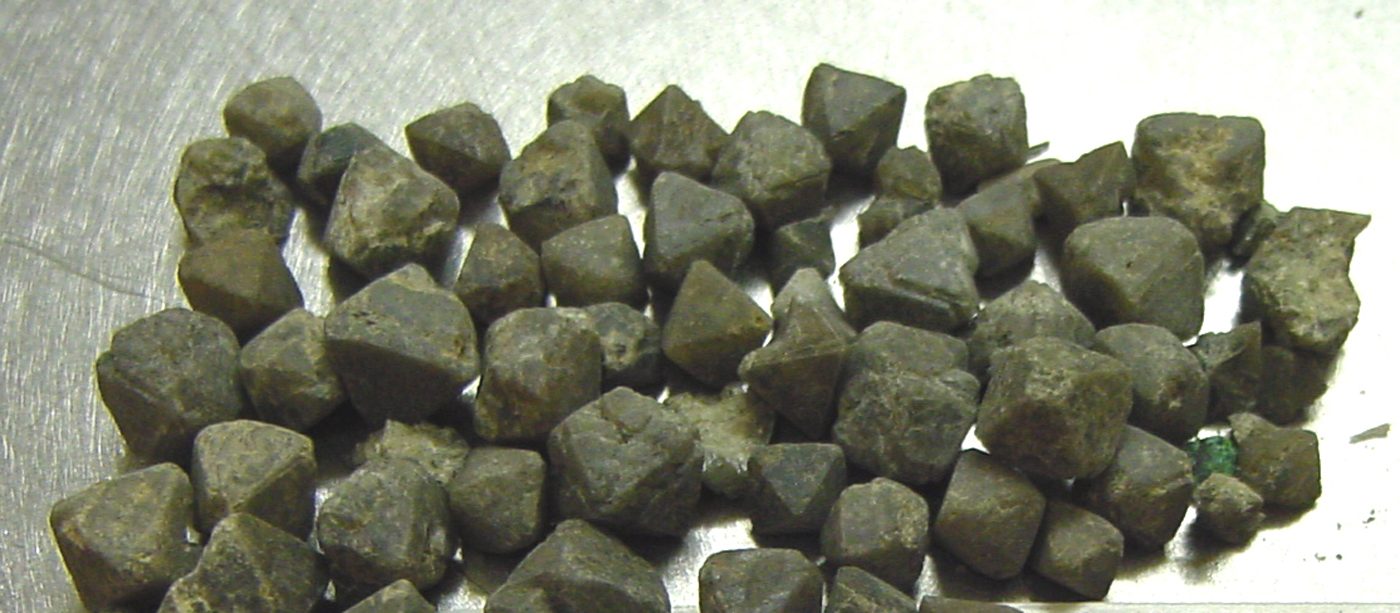
Northupite octahedra, locality not given. Mineral collection of Bringham Young University Department of Geology, Provo, Utah. Photograph by Andrew Silver. BYU index 6- 9037, MgCO_3-Na_2CO_3-NaCl. — Photo: Wikimedia Commons · Public domain
Northupite
An uncommon evaporite mineral — sodium-magnesium carbonate-chloride forming octahedral crystals.
Intro adapted from Wikipedia (CC BY-SA).
Northupite is an IMA-recognized mineral species in the carbonate class, with the chemical formula Na₃Mg(CO₃)₂Cl.
It crystallizes in the cubic crystal system (space group Fd3m). It is a member of the Northupite structural group.
Key properties: Mohs hardness 3.5–4; specific gravity 2.38–2.41; Vitreous luster; refractive index 1.532; optically isotropic.
IMA symbol Nup, grandfathered status — known before the IMA’s founding, named in 1895.
An uncommon mineral, formed probably between 20° C and 50° C, as a lacustrine deposit or at depth in mud and clay; may be primary or a replacement of earlier saline minerals.
It is found associated with Tychite, pirssonite (Searles Lake, California, USA); shortite, trona, pirssonite, gaylussite, labuntsovite, searlesite, norsethite, loughlinite, pyrite.
The mineral was named to honor Charles H. Northup (1861–?), grocer of San Jose, California, USA, who found the first examples.