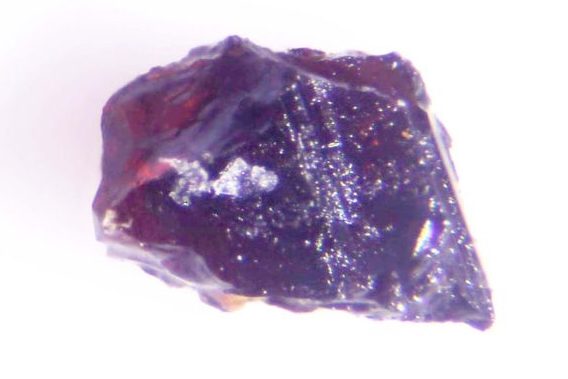
A outstanding reddish single crystal of the very rare niobium-tantalum mineral olmsteadite from the type locality in South Dakota (Big Chief Mine, Keystone, Glendale, Pennington County, South Dakota, United States of America). Ex Vandenbroucke Museum collection from Waregem, Belgium. — Photo: David Hospital · CC BY 4.0
Olmsteadite
Olmsteadite is an IMA-recognized mineral species in the phosphate class, with the chemical formula KFe²⁺₂NbO₂(PO₄)₂·2H₂O.
It crystallizes in the orthorhombic crystal system (space group Pb2_1m).
Key properties: Mohs hardness 4; specific gravity 3.31–3.36; Olive-green streak; Subadamantine, may be bronzy luster; optically biaxial.
IMA symbol Osd, IMA status: approved, named in 1974.
A rare mineral, presumably formed by hydrothermal leaching of primary phosphates and columbite-tantalite in complex granite pegmatites.
It is found associated with Siderite, quartz (Big Chief mine, South Dakota, USA); rockbridgeite (Hesnard mine, South Dakota, USA).
The mineral was named to honor Milo Olmstead, Rapid City, South Dakota, USA, amateur collector of microscopic minerals, who called attention to the mineral.