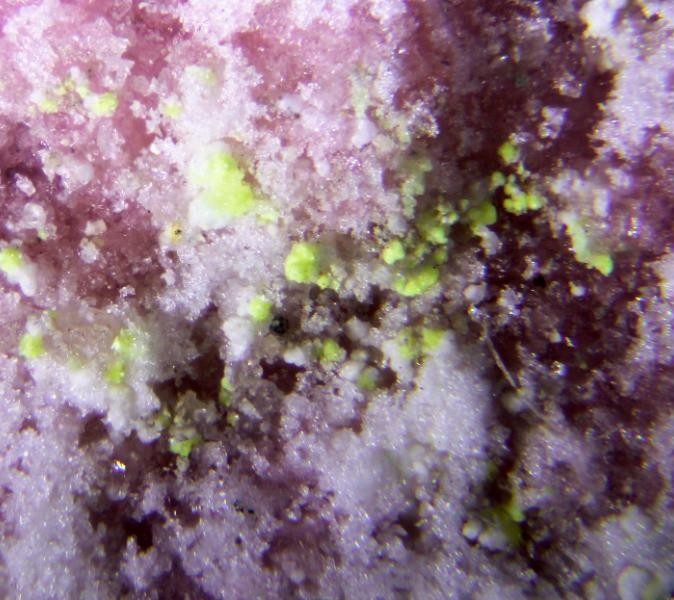
Yellow ottohahnite microcrystals associated to a mixture of manganoblödite & cobaltoblödite (confirmed by SEM-EDS) and also associated to bluelizardite and plasilite after the label. From Blue Lizard Mine, Red Canyon, San Juan County, Utah, United States of America. Ex. Erich Laskowski collection (USA). — Photo: David Hospital · CC BY 4.0
Ottohahnite
Ottohahnite is an IMA-recognized mineral species in the sulfate class, with the chemical formula Na₆(UO₂)₂(SO₄)₅(H₂O)₇·1.5H₂O.
It crystallizes in the triclinic crystal system (space group P-1).
Key properties: Mohs hardness 2.5; specific gravity 2.973; Pale green-yellow streak; Vitreous luster; optically biaxial.
IMA symbol Ohn, IMA status: approved, named in 2015.
Occurs as efflorescent crusts on mine walls, formed by hydration-oxidation weathering of primary uranium minerals (mainly uraninite) by acidic solutions from the decomposition of sulfides.
It is found associated with Tamarugite, blödite, bluelizardite, bobcookite, epsomite, gypsum, hexahydrite, konyaite, plášilite.
The mineral was named to honor German chemist Otto Hahn (1879-1968) who discovered nuclear fission (of uranium) in 1938, for which he received the Nobel Prize in Chemistry.