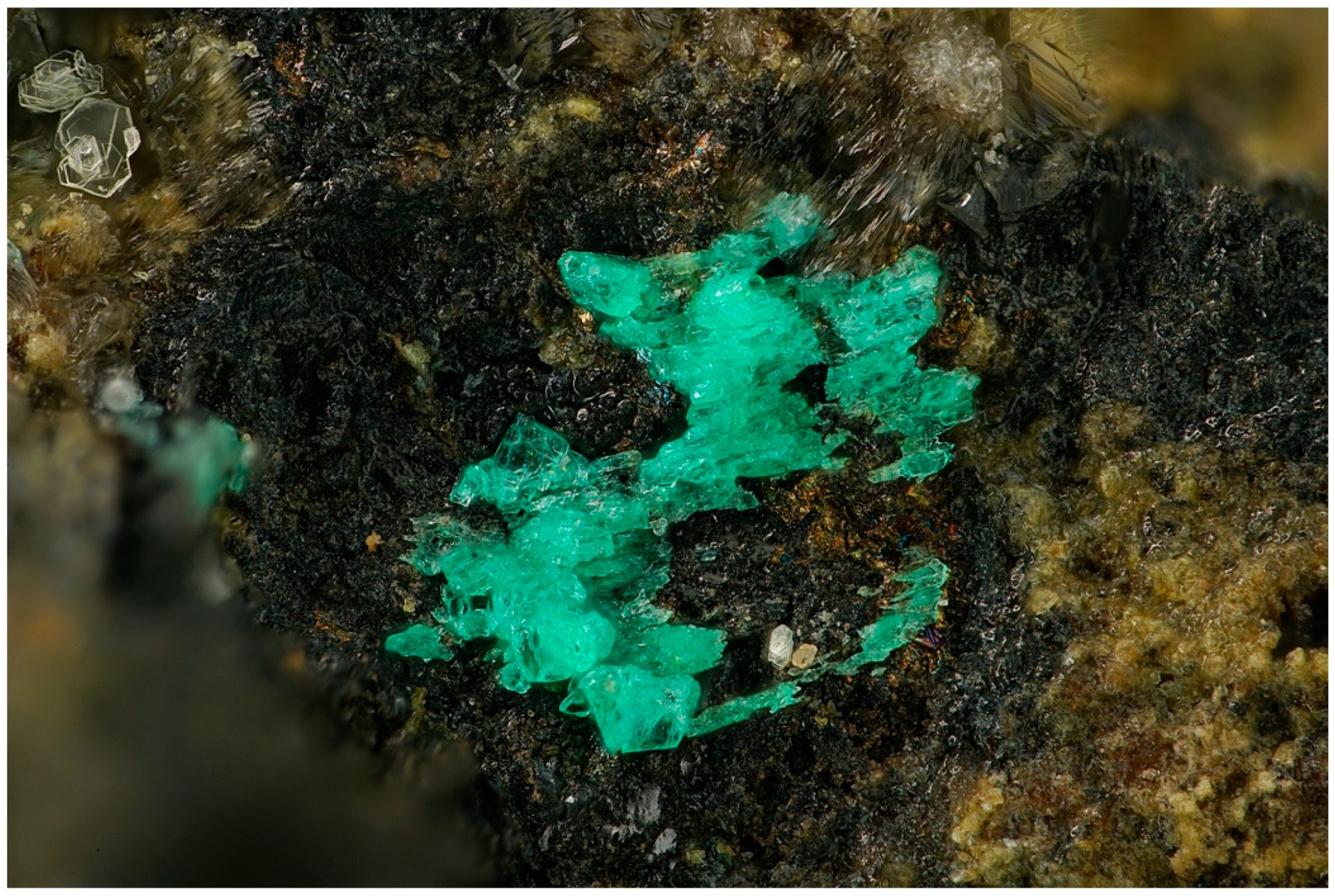
Thin green platelettes of paddlewheelite coating chalcopyrite and andersonite. Horizontal field of view is 2 mm. Photo by Stephan Wolfsried. The image belongs to the article "Paddlewheelite, a New Uranyl Carbonate from the Jáchymov District, Bohemia, Czech Republic", an open access article distributed under the terms and conditions of the Creative Commons Attribution (CC BY) license ( https://creativecommons.org/licenses/by/4.0/ ). — Photo: Stephan Wolfsried · CC BY 4.0
Paddlewheelite
Paddlewheelite is an IMA-recognized mineral species in the carbonate class, with the chemical formula MgCa₅Cu₂(UO₂)₄(CO₃)₁₂(H₂O)₃₃.
It crystallizes in the monoclinic crystal system (space group Pc).
Key properties: Mohs hardness 2; specific gravity 2.497; Very pale blue-green streak; Sub-adamantine luster; optically biaxial.
IMA symbol Pdw, IMA status: approved, named in 2018.
A secondary oxidation product of uraninite, formed by concomitant dissolution of uraninite, calcite, dolomite, chalcopyrite, and andersonite, in a weathered hydrothermal Ag-Co-Ni- Bi-As±U (five-element vein type) ore deposit.
It is found associated with Calcite, dolomite, chalcopyrite, andersonite, uraninite, quartz, hematite, goethite (var. “sammetblende”).
Alludes to the geometry of uranyl tricarbonate units in the atomic structure, which resemble steamboat “paddle-wheels”.