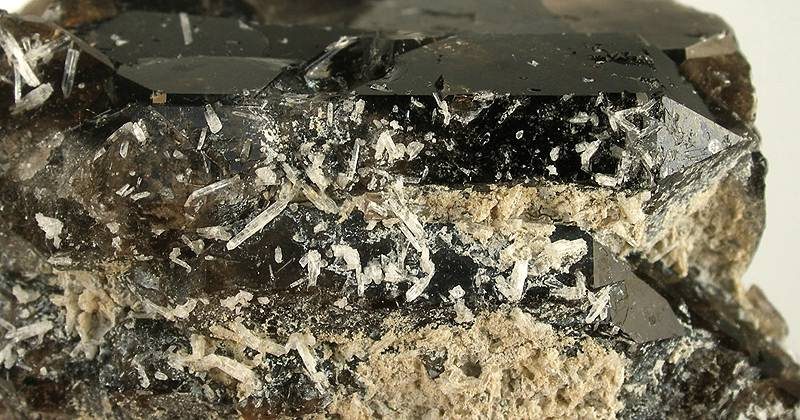
Palermoite Locality: Palermo No. 1 Mine (Palermo #1 pegmatite), Groton , Grafton County , New Hampshire , USA ( Locality at mindat.org ) Size: small cabinet, 7.2 x 5.2 x 4.7 cm Palermoite Palermoite is a very rare phosphate, first found in 1952 at this type locality for the species. To date, it has been found at just a few other locales, and still these crystals are the best. This particularly rich specimen is one of the larger, richer specimens with display aesthetics overall, according to Bob Whitmore. It has hundreds of palermoite crystals, many still covered by pocket clay just the way he found it. The top portion has been cleaned a bit, to reveal sharp crystals to 4mm nicely contrasted on lustrous, dark smoky quartz. Ex. Robert Whitmore Collection. — Photo: Robert M. Lavinsky · CC BY-SA 3.0
Palermoite
Palermoite is an IMA-recognized mineral species in the phosphate class, with the chemical formula Li₂SrAl₄(PO₄)₄(OH)₄.
It crystallizes in the orthorhombic crystal system (space group Immm). It is a member of the Carminite structural group.
Key properties: Mohs hardness 5.5; specific gravity 3.22; White streak; Vitreous to subadamantine luster; optically biaxial.
IMA symbol Ple, grandfathered status — known before the IMA’s founding, named in 1953.
A late hydrothermal product in a complex zoned granite pegmatite (Palermo #1 mine, New Hampshire, USA); near quartz veins in sandstones and conglomerates subjected to greenschist metamorphism (Giogo di Toirano, Italy).
It is found associated with Siderite, childrenite–eosphorite, beraunite, crandallite, whitlockite, brazilianite, goyazite, apatite, quartz (Palermo #1 mine, New Hampshire, USA); lazulite.
The name refers to its occurrence at the Palermo #1 mine, New Hampshire, USA.