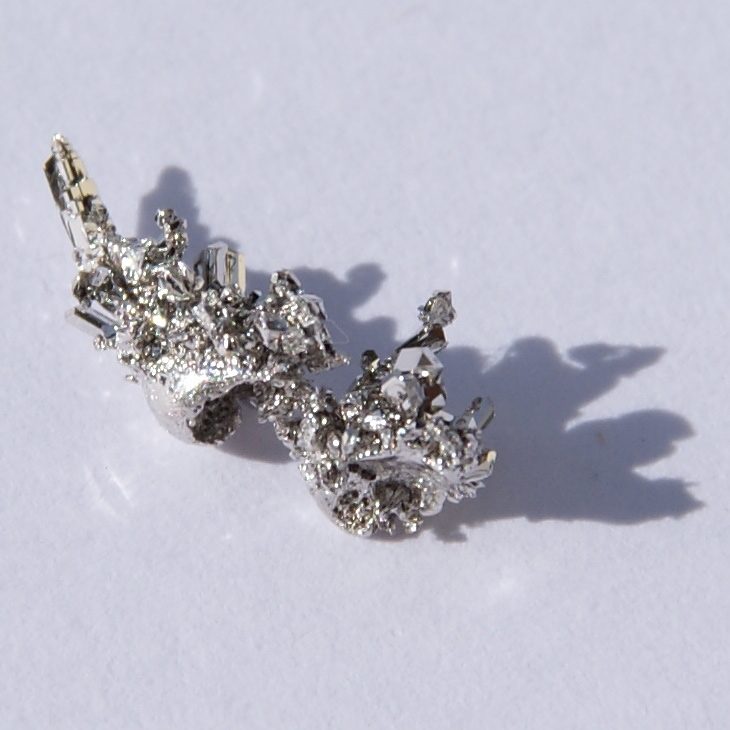
The noble metal palladium is very similar to platinum, and, like platinum, is often used for catalysts and for jewellery. Palladium is more reactive than platinum. Palladium has excellent capability to absorb, store, and then release hydrogen. — Photo: Hi-Res Images of Chemical Elements · CC BY 3.0
Palladium
A rare silvery-white platinum-group metal (symbol Pd, atomic number 46) — catalyst, investment metal, and occasional native element.
Intro adapted from Wikipedia (CC BY-SA).
Palladium is an IMA-recognized mineral species in the native element class, with the chemical formula Pd.
It crystallizes in the cubic crystal system (space group Fm3m). It is a member of the Copper structural group.
Key properties: Mohs hardness 4.5–5; specific gravity 11.9; Metallic. R: (400) 60.6, (420) 62.0, (440) 63.4, (460) 64.6, (480) 65.6, (500) 66.4, (520) 67.2, (540) 67.8 luster.
IMA symbol Pd, grandfathered status — known before the IMA’s founding, named in 1803.
An oxidation product of palladium-bearing sulfides and as a primary phase in platinum deposits.
It is found associated with Pt–Fe alloys, Pd–Hg minerals, gold, Au–Ag alloy, lead, sobolevskite.
In honor of the discovery of the planetoid Pallas.