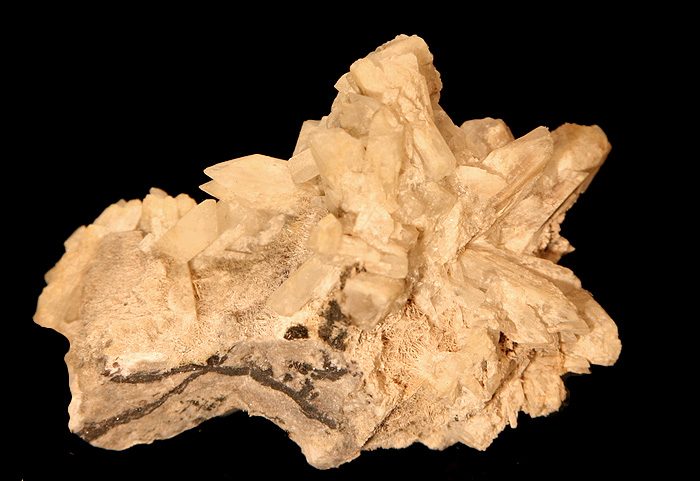
Paracelsian Locality: Benallt Mine (Tyddyn Meirion mine; Ty Canol mine), Rhiw , Llanfaelrhys , Lleyn Peninsula , Gwynedd (Caernarvonshire) , Wales , UK ( Locality at mindat.org ) This specimen features SHARP freestanding paracelsian crystals to 1.5 cm and several larger though cruder crystals as well. It is of exceptional quality for the species and actually is a fairly displayable specimen considering its intrinsic relative ugliness. For what it is, a very important piece and with excellent history! I believe that Sir Russell actually collected the bulk, if not all, of these specimens. THERE HAVE NOT BEEN MORE IN ALMOST 100 YEARS! 6.2 x 4.1 x 3.9 cm — Photo: Robert M. Lavinsky · CC BY-SA 3.0
Paracelsian
A barium feldspar — BaAl₂Si₈ — the barium analogue of celsian's structural family.
Intro adapted from Wikipedia (CC BY-SA).
Paracelsian is an IMA-recognized mineral species in the silicate class, with the chemical formula Ba(Al₂Si₂O₈).
It crystallizes in the monoclinic crystal system (space group P2_1/a). It is a member of the Danburite structural group.
Key properties: Mohs hardness 6; specific gravity 3.29–3.32; Vitreous luster; optically biaxial.
IMA symbol Pcls, grandfathered status — known before the IMA’s founding, named in 1905.
Found in a band through shales and sandstones, in association with a metamorphosed manganese deposit (Benallt mine, Wales).
It is found associated with Celsian (Benallt mine, Wales).
A combination of the Greek para, for near, and the mineral's dimorph, celsian.