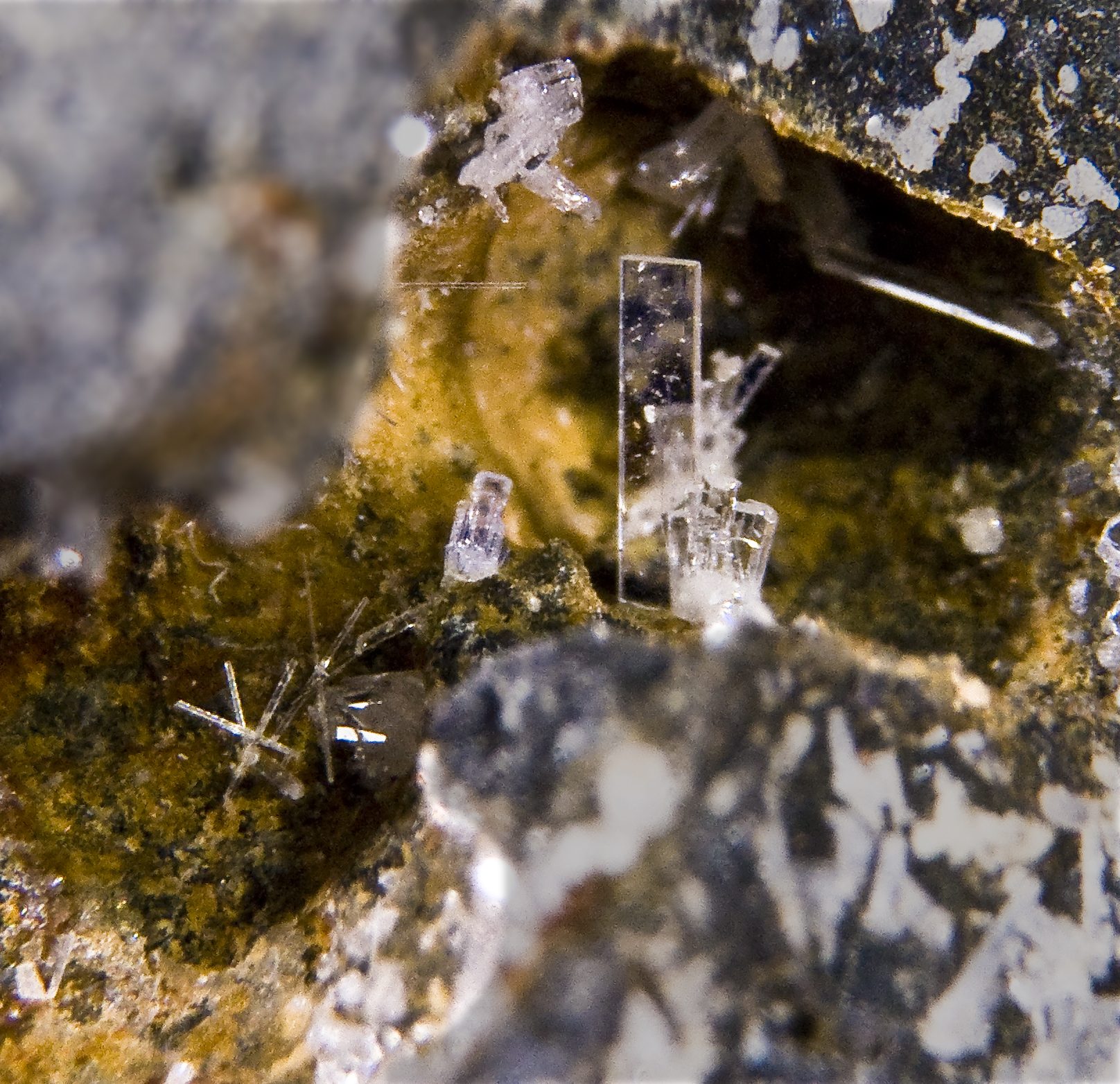
Paralaurionite Locality : Thorikos Bay slag locality, Thorikos area, Lavrion District slag localities, Lavrion (Laurion; Laurium) District, Attikí (Attica; Attika) Prefecture, Greece Size : (view 0.6 × 0.5 cm) — Photo: Didier Descouens · CC BY-SA 3.0
Paralaurionite
The monoclinic dimorph of laurionite — a colorless lead hydroxychloride of the matlockite group.
Intro adapted from Wikipedia (CC BY-SA).
Paralaurionite is an IMA-recognized mineral species in the halide class, with the chemical formula PbCl(OH).
It crystallizes in the monoclinic crystal system (space group C2/m).
Key properties: Mohs hardness 3; specific gravity 6.05–6.15; Subadamantine luster; refractive index 2.133; optically biaxial.
IMA symbol Plri, grandfathered status — known before the IMA’s founding, named in 1899.
A secondary mineral formed through alteration of lead-bearing slag by sea water or in hydrothermal polymetallic mineral deposits.
It is found associated with Laurionite, penfieldite, fiedlerite, phosgenite (Laurium, Greece); leadhillite, matlockite, cerussite, hydrocerussite, diaboleite, wherryite (Tiger, Arizona.
Its name comes from the Greek for near, for the dimorphous relation to laurionite.