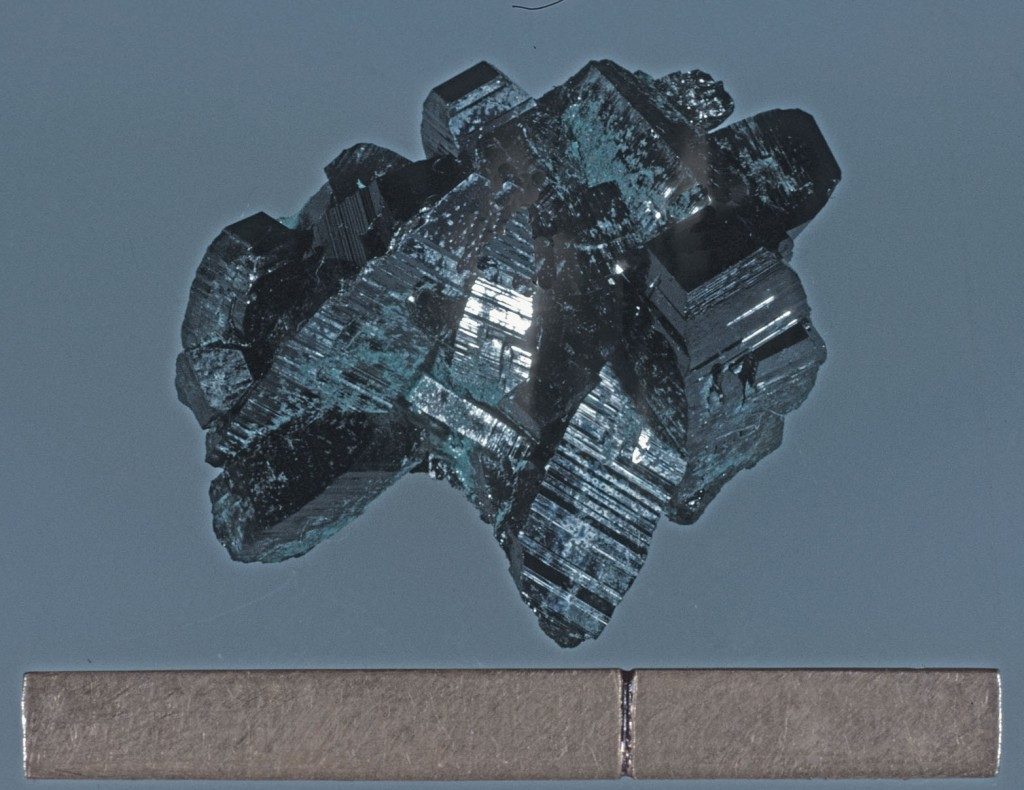
Paramelaconite Locality: Copper Queen Mine (Halero Mine), Queen Hill, Bisbee, Warren District, Mule Mountains, Cochise County, Arizona, USA Paramelaconite. Specimen is from the collection of Rock Currier (1975). Scale at bottom of image is an inch with a rule at one cm. — Photo: Rock Currier · CC BY 3.0
Paramelaconite
A rare black mixed-valence copper oxide (Cu₄O₃) discovered in 1890 at Bisbee's Copper Queen mine.
Intro adapted from Wikipedia (CC BY-SA).
Paramelaconite is an IMA-recognized mineral species in the oxides & hydroxide class, with the chemical formula Cu¹⁺₂Cu²⁺₂O₃.
It crystallizes in the tetragonal crystal system (space group I4_1/amd).
Key properties: Mohs hardness 4.5; specific gravity 6.04–6.11; Brownish black streak; Brilliant metallic to adamantine luster; optically uniaxial.
IMA symbol Pml, grandfathered status — known before the IMA’s founding, named in 1891.
Found as a very rare secondary mineral in hydrothermal copper deposits.
It is found associated with Cuprite, tenorite, connellite, malachite, goethite (Bisbee, Arizona, USA); cuprite, tenorite, chrysocolla, malachite, plancheite, dioptase.
Its name comes from the Greek for near and melaconite, which in turn was named for black and dust, now a synonym for tenorite.