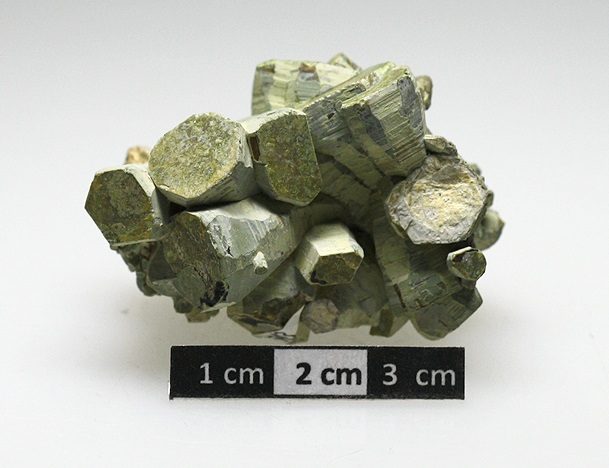
Parisite-(La , Bastnäsite-(La) Dimensions: 50mm x 35mm x 35mm Locality: Mula claim, Tapera, Novo Horizonte, Bahia, Brazil Description: One of the best samples of the new mineral parisite-(La). Luiz Menezes collection. — Photo: Ricardo Scholz · Public domain
Parisite-(La)
Parisite-(La) is mineral discovered by Daniel Atencio of the University of São Paulo and colleagues in the Mula claim, Bahia, Brazil. Parisite-(La) is the lanthanum analog of parisite-(Ce), which has the same structure, but with cerium substituted for lanthanum. Parisite-(La) is chemically similar to synchysite-(La). The type material for parisite-(La) resides in the mineralogical collections of the Museu de Ciência e Técnica, Escola de Minas, Universidade Federal de Ouro Preto, Minas Gerais, Brazil, and at the University of Arizona Mineral Museum, Tucson, Arizona.
Intro adapted from Wikipedia (CC BY-SA).
Parisite-(La) is an IMA-recognized mineral species in the carbonate class, with the chemical formula CaLa₂(CO₃)₃F₂.
It crystallizes in the monoclinic crystal system. It is a member of the Parisite structural group.
Key properties: Mohs hardness 4–5; specific gravity 4.273; White streak; Vitreous to dull luster.
IMA symbol Pst-La, IMA status: approved, named in 2016.
Found in brecciated, hydrothermal quartz veins cemented by chalcedony hosted by metarhyolite formed as a result of peraluminous and alkaline magmatism during continental rifting.
It is found associated with Almedaite, hematite, rutile, fluocerite-(Ce), brockite, monazite-(La), rhabdophane-(La), bastnasite-(La).
Designates the La-dominant analogue of parisite-(Ce).