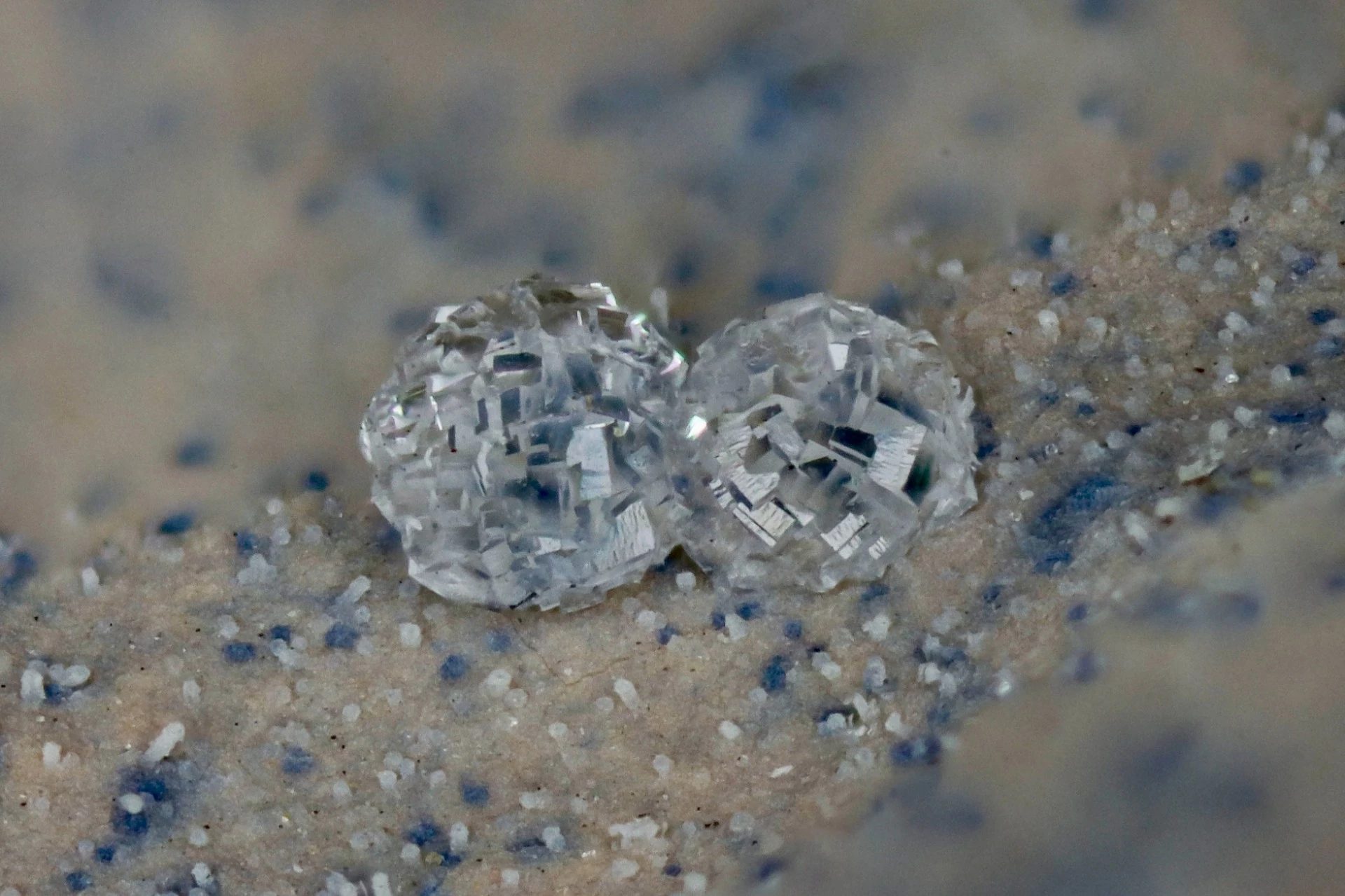
Paulingite-K Field of view: 0.4 mm Locality: Agua Amarga, Cabo de Gata volcanic complex, Níjar, Almería, Andalusia, Spain ( locality at mindat.org ) — Photo: Henk Smeets – tomeikminerals.com · CC BY 4.0
Paulingite-K
Paulingite or paulingite-K is a rare zeolite mineral that is found in vesicles in the basaltic rocks from the Columbia River near Rock Island Dam, Washington. Paulingite was named for Linus Carl Pauling (1901–1994), professor of chemistry, California Institute of Technology and accepted by the International Mineralogical Association in 1960. The early formation in the crystallization sequence and the high water content suggest that paulingite forms from relatively dilute pore fluids. They have a large unit cell of 3.51 nanometers and an isometric crystal system.
Intro adapted from Wikipedia (CC BY-SA).
Paulingite-K is an IMA-recognized mineral species in the silicate class, with the chemical formula (K,Ca,Na,Ba, )₁₀(Si,Al)₄₂O₈₄·34H₂O.
It crystallizes in the cubic crystal system (space group Im3m).
Key properties: Mohs hardness 5; specific gravity 2.085; Vitreous luster.
IMA symbol Pau-K, IMA status: approved, named in 1960.
Found in vesicles in basalt flows.
It is found associated with Zeolites, pyrite, calcite.
The name refers to Linus Carl Pauling (1901–1994), Nobel Laureate, Professor of Chemistry, California Institute of Technology, Pasadena, California, USA.