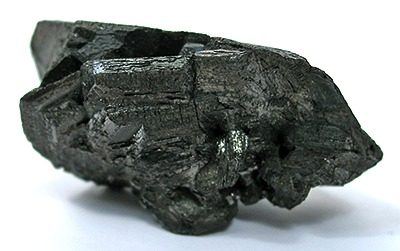
Pearceite-Tac Locality: Guanajuato , Mexico ( Locality at mindat.org ) Size: miniature, 4.5 x 3.6 x 2.2 cm Pearceite At 4.5 cm long, this is pronounced by those who know more than I to be the finest known example of this rare species from Mexico, and perhaps in the world (per Terry Wallace, Wendell Wilson, and others familiar with the collection, as printed in the Romero Book). It is a sharp, lustrous specimen with no damage that is thought to have been recovered prior to the 1940s. This specimen from the Dr Miguel Romero collection was on loan exhibition to the University of Arizona Museum for over a decade, until my purchase of this collection in 2008. It was on display in special cases at the museum, and has since been featured in the book "The Miguel Romero Collection of Mexico Minerals" which we sponsored as a special supplement book (published by the Mineralogical Record in December of 2008). — Photo: Robert M. Lavinsky · CC BY-SA 3.0
Pearceite
Pearceite is an IMA-recognized mineral species in the sulfosalt class, with the chemical formula [Ag₉CuS₄][(Ag,Cu)₆(As,Sb)₂S₇].
It crystallizes in the hexagonal crystal system (space group P-3m1). It is a member of the Polybasite structural group.
Key properties: Mohs hardness 3; specific gravity 6.15; Black streak; Metallic luster.
IMA symbol Pea, IMA status: approved, named in 1896.
Found in hydrothermal deposits formed at low to medium temperatures.
It is found associated with Acanthite, silver, proustite, quartz, barite, calcite.
The name refers to Dr. Richard Pearce (1837–1927), Cornish–American chemist and metallurgist, Denver, Colorado, USA.