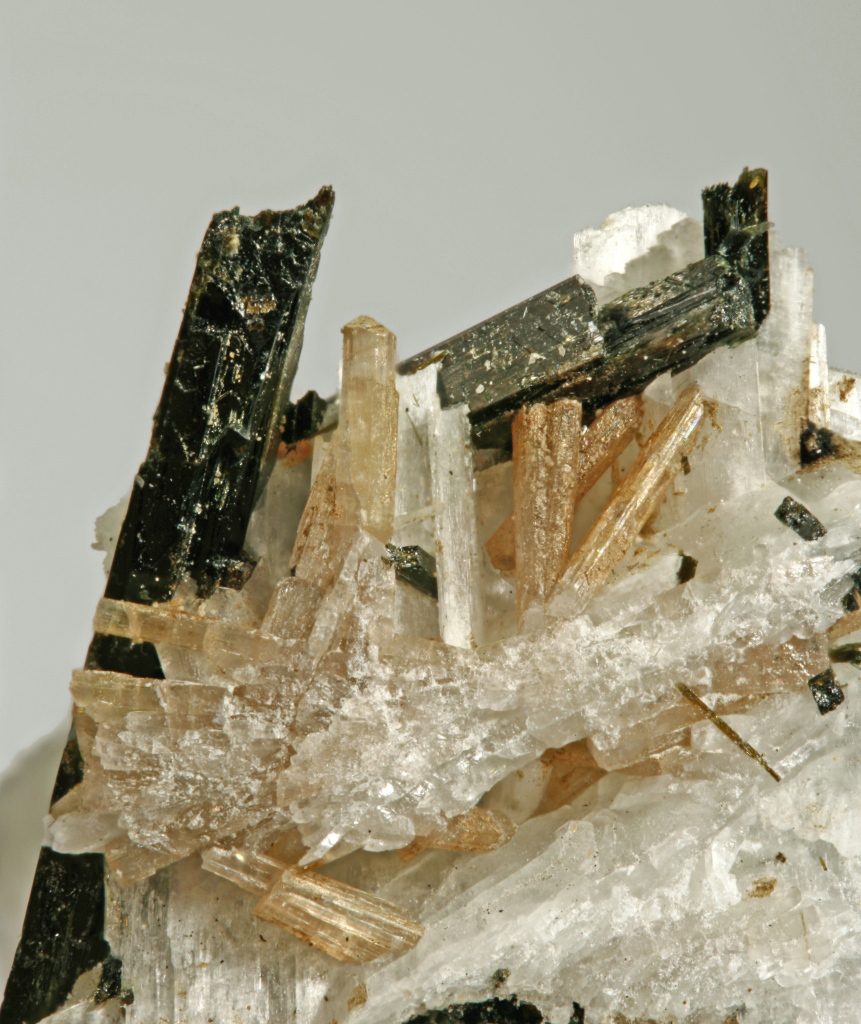
Petersenite-(Ce) Locality: Poudrette quarry (Demix quarry; Uni-Mix quarry; Desourdy quarry; Carrière Mont Saint-Hilaire), Mont Saint-Hilaire, La Vallée-du-Richelieu RCM, Montérégie, Québec, Canada The petersenite-(Ce) xls are ~ 5 mm. Via Jean-Pierre Beckerich. MOB coll. This is from the Poudrette pegmatite. The black aegirine prisms are all broken. The petersenite-(Ce) apears very fresh and unaltered (but some of it has a thin orangey coating.) It was associated with adamsite-(Y). It has very strong REE absorbtion lines but has not been analyzed. So I can't completely rule out other REE bearing burbankite family species (such as calcioburbankite). — Photo: Modris Baum · Public domain
Petersenite-(Ce)
Petersenite-(Ce) is an IMA-recognized mineral species in the carbonate class, with the chemical formula Na₄Ce₂(CO₃)₅.
It crystallizes in the monoclinic crystal system (space group P2_1). It is a member of the Burbankite structural group.
Key properties: Mohs hardness 3; specific gravity 3.69; White streak; Vitreous luster; optically biaxial.
IMA symbol Pet-Ce, IMA status: approved, named in 1992.
A rare component in pegmatites in nepheline–sodalite syenite near a contact with a hornfels unit, in association with an intrusive alkalic gabbro-syenite complex (Mont Saint-Hilaire, Canada).
It is found associated with Aegirine, albite, microcline, “biotite”, “chlorite”, polylithionite, calcite, rhodochrosite, analcime, catapleiite, epididymite, eudialyte, serandite.
The mineral was named to honor Dr. Ole Valdemar Petersen (1939–), Curator, Geology Museum, Copenhagen, Denmark, for his work on the mineralogy of alkaline rocks.