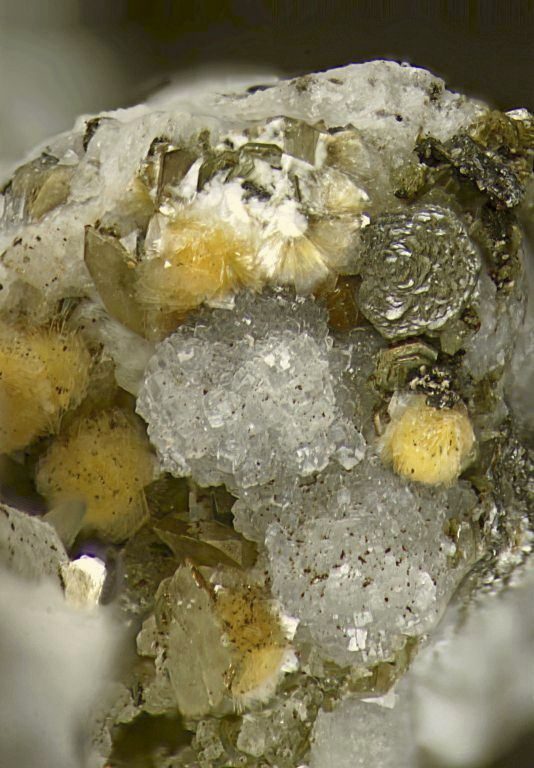
Phillipsite-K (FOV 4.5 x 6.3 mm) Locality: Poudrette quarry (Demix quarry; Uni-Mix quarry; Desourdy quarry; Carrière Mont Saint-Hilaire), Mont Saint-Hilaire, Rouville RCM, Montérégie, Québec, Canada Found May 1997. MOB coll. Phillipsite balls with yellow gmelinite and a dark green rosette of a donnayite group mineral (top right). (There are also some unid olive green hex tabular xls - muscovite?) (Note: I say "donnayite group" rather than "synchysite-(Ce)" because the aggregate has a typical "kettle drum" back side. But it has not been analyzed.) The phillipsite was ID (on another sample) via optics. It is probably –K because that is the only variety listed by Horvath (Lapis 7-8/200) for this environment (contact zone - specifically Poudrette pegmatite). — Photo: Modris Baum · Public domain
Phillipsite-K
Phillipsite-K is an IMA-recognized mineral species in the silicate class, with the chemical formula K₆(Si₁₀Al₆)O₃₂·12H₂O.
It crystallizes in the monoclinic crystal system (space group P2_1/m). It is a member of the Harmotome structural group.
Key properties: Mohs hardness 4–4.5; specific gravity 2.2; White streak; Vitreous luster; optically biaxial.
IMA symbol Php-K, IMA status: approved, named in 1997.
is typically found in cavities in basalt, of hydrothermal origin; an authigenic mineral in saline lake and hot spring deposits and calcareous deep-sea sediments.
It is found associated with Zeolites, apophyllite, calcite, nosean, nepheline, olivine, melilite, celadonite.
The name refers to William Phillips (1775–1828), noted British mineralogist.