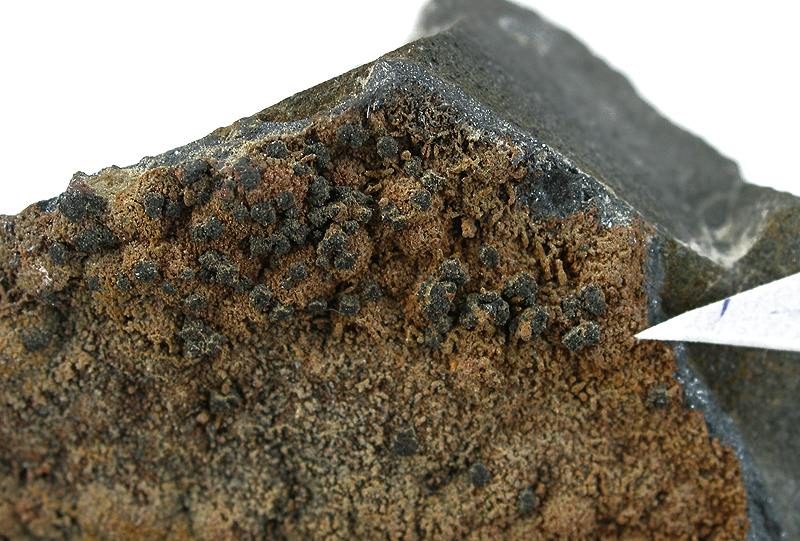
Pirquitasite , Toyohaite Locality: Pirquitas Ag-Sn Deposit, Rinconada Department, Jujuy , Argentina ( Locality at mindat.org ) Size: small cabinet, 9.7 x 8.0 x 5.8 cm Toyohaite with Pirquitasite ex. Dr. Werner Paar Collection TOYOHAITE, in xls (!!) is super-rare. This specimen features multiple EYE-VISIBLE crystals to about 1mm, clearly contrasted upon the sparkling sulfide matrix. It is richly impressive. This is the richest specimen available for sale from his supply, according to Dr. Paar. This specimen has a small zone of analysed Pirquitasite - see arrow (this is obviously the type locality). They are not readily eye-visible in these photos, but there are many seen with a loupe and in person looking into the cavity (hence the price). It has a display quality, that is nice. All crystals are nicely protected in a shallow cavity, as well. This is the Ag-rich end member of the rhodostannite-toyohaite solid solution series. A very rare mineral originally described from the Toyoha mine in Japan where it occurred in microscopic grains only. For the first time, the new occurrence in Argentina provides large xls of this species (+/- 1 mm) grown on franckeite-potosiite, and associated with other rare minerals like pirquitasite, cylindrite and fizelyite-ramdohrite. The mineral has a "pseudo-cubic" shape and looks like pyrrhotite. Only very few specimens with xls were recovered, and chances to find additional material are almost none. A "must" for any collector of rare Ag minerals. The mineral was microprobed and almost exaxctly correponds to the end member composition — Photo: Robert M. Lavinsky · CC BY-SA 3.0
Pirquitasite
Pirquitasite is an IMA-recognized mineral species in the sulfide class, with the chemical formula Ag₂ZnSnS₄.
It crystallizes in the tetragonal crystal system (space group I-4). It is a member of the Sphalerite, Stannite structural group.
Key properties: specific gravity 4.822; Metallic. Anisotropism: Strong, from brick-red to pale green. R1 –R2: (400) 23.9–24.4, (420) 23.4–24.0 luster.
IMA symbol Pi, IMA status: approved, named in 1980.
Occurs as hydrothermal mineralization in veins in association with subvolcanic environments, similar to the classic Bolivian tin and silver deposits (Pirquitas deposit, Argentina).
It is found associated with Hocartite, pyrite, marcasite, wurtzite, franckeite, miargyrite, aramayoite, chalcostibite, stannite, kesterite, rhodostannite, cassiterite (Pirquitas deposit.
The name is taken from the type locality at the Pirquitas deposit in Argentina.