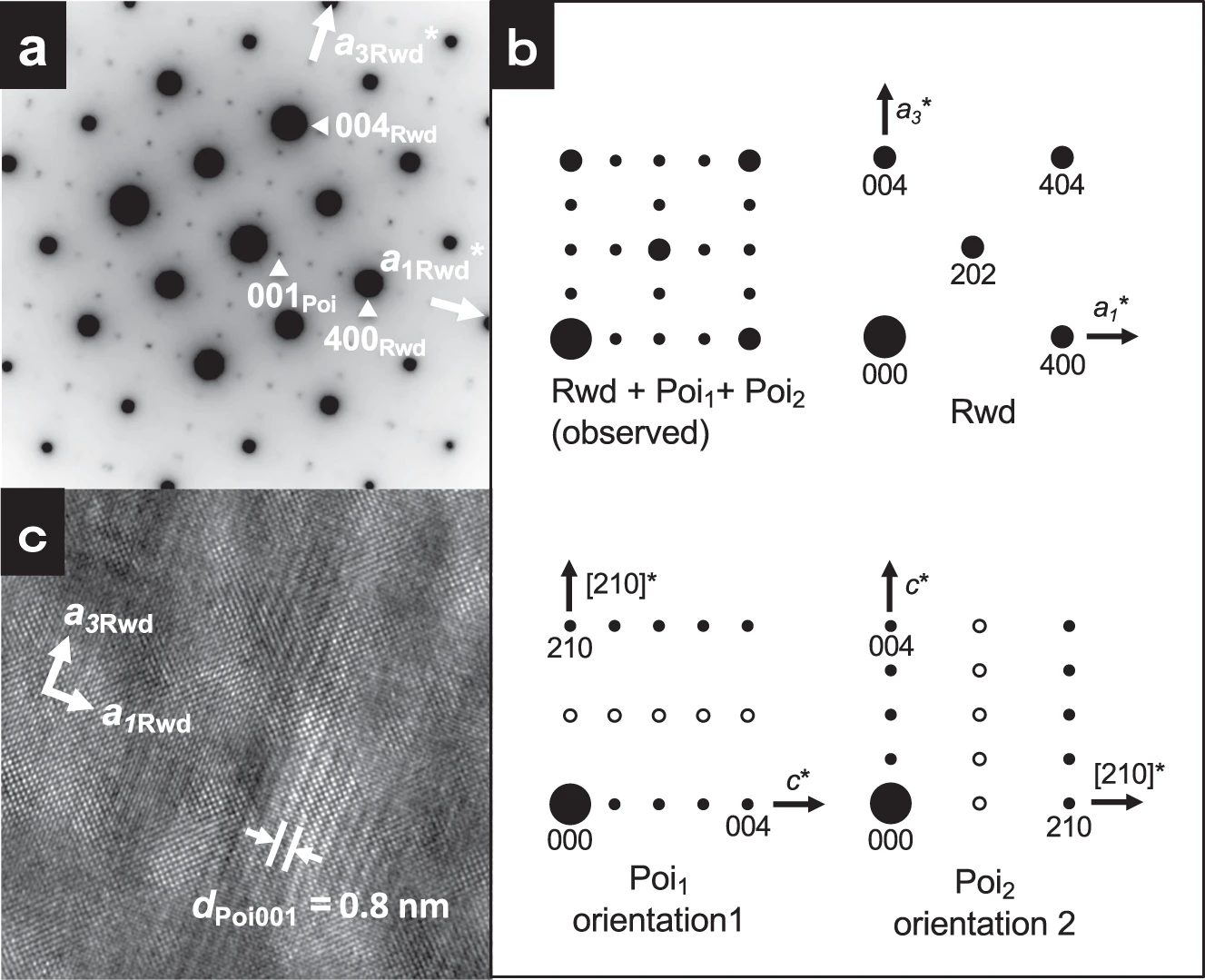
a Selected-area electron diffraction (SAED) pattern of a ringwoodite grain along the [010] zone axis and (b) its schematic illustration. The grain contains poirierite in two different but equivalent orientations (domain 1: Poi1, domain 2: Poi2). Domain 2 is rotated by 90° along [010]Rwd compared with the orientation of domain 1. The open circles denote diffraction spots from the poirierite caused by dynamical diffraction by the overlying host ringwoodite. c High-resolution transmission electron micrograph showing 0.8 nm fringes corresponding to dPoi001. The image is published in an open access article distributed under the terms and conditions of the Creative Commons Attribution (CC BY) license ( https://creativecommons.org/licenses/by/4.0/ ). — Photo: Naotaka Tomioka, Luca Bindi, Takuo Okuchi, Masaaki Miyahara, Toshiaki Iitaka, Zhi Li, Tsutomu Kawatsu, Xiande Xie, Narangoo Purevjav, Riho Tani & Yu Kodama · CC BY 4.0
Poirierite
Poirierite is an IMA-recognized mineral species in the silicate class, with the chemical formula Mg₂SiO₄.
It crystallizes in the orthorhombic crystal system (space group Pmma).
Key properties: specific gravity 3.326.
IMA symbol Poi, IMA status: approved, named in 2020.
Found in melt veins of shocked chondritic meteorites, perhaps developed during rapid decompression at relatively low temperature in retrograde shock metamorphism.
It is found associated with Ringwoodite, wadsleyite. Distribution From the Suizhou meteorite, fell at Xihe, Zengdu District, Suizhou, Hubei, China (holotype), the Tenham meteorite.
The mineral was named to honor Jean-Paul Poirier, for contributions to mineral physics, including the theoretical prediction of ε-Mg2SiO4.