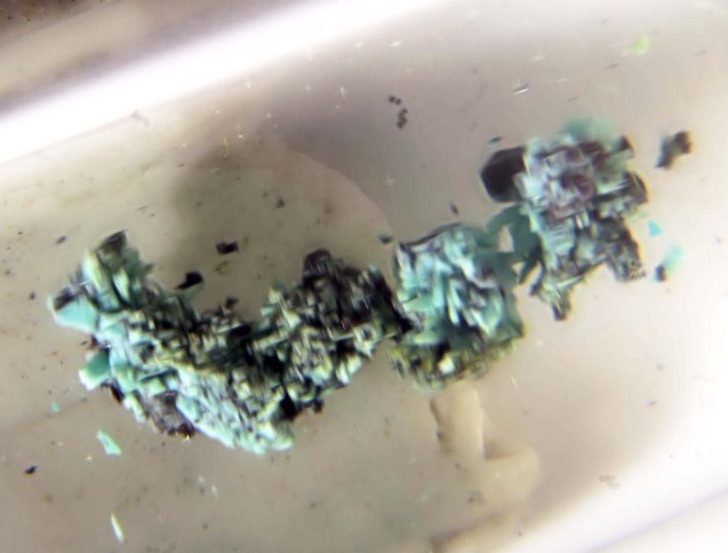
Red-brown microcrystals of ponomarevite, an extremely rare K-Cu chloride from the famous Tolbachik volcano (Tolbachik Volcano, Kamchatka Krai, Russian Federation) the only known locality and associated to green crystals of klyuchevskite. The ponomarevite crystals are difficult to see in the photo. The sample is stored in a closed vial to avoid decomposition in the air atmosphere. Ex Vandenbroucke Museum collection from Waregem, Belgium. — Photo: David Hospital · CC BY-SA 4.0
Ponomarevite
Ponomarevite is an IMA-recognized mineral species in the halide class, with the chemical formula K₄Cu₄OCl₁₀.
It crystallizes in the monoclinic crystal system (space group C2/c).
Key properties: Mohs hardness 2.8; specific gravity 2.78; Red-orange streak; Vitreous, resinous to greasy in aggregates luster; optically biaxial.
IMA symbol Pon, IMA status: approved, named in 1986.
Found as a fracture filling and in fumaroles, deposited from 280–400 ° C.
It is found associated with Halite, sylvite, tenorite, tolbachite, dolerophanite, piypite, chalcocyanite, cotunnite, sofiite, klyuchevskite, kamchatkite.
The mineral was named to honor Vasilii Vasil’evich Ponomarev (1940–1976), Russian vulcanologist, Institute of Volcanology, Petropavlovsk-Kamchatskii, Russia, who early studied the Tolbachik volcano.