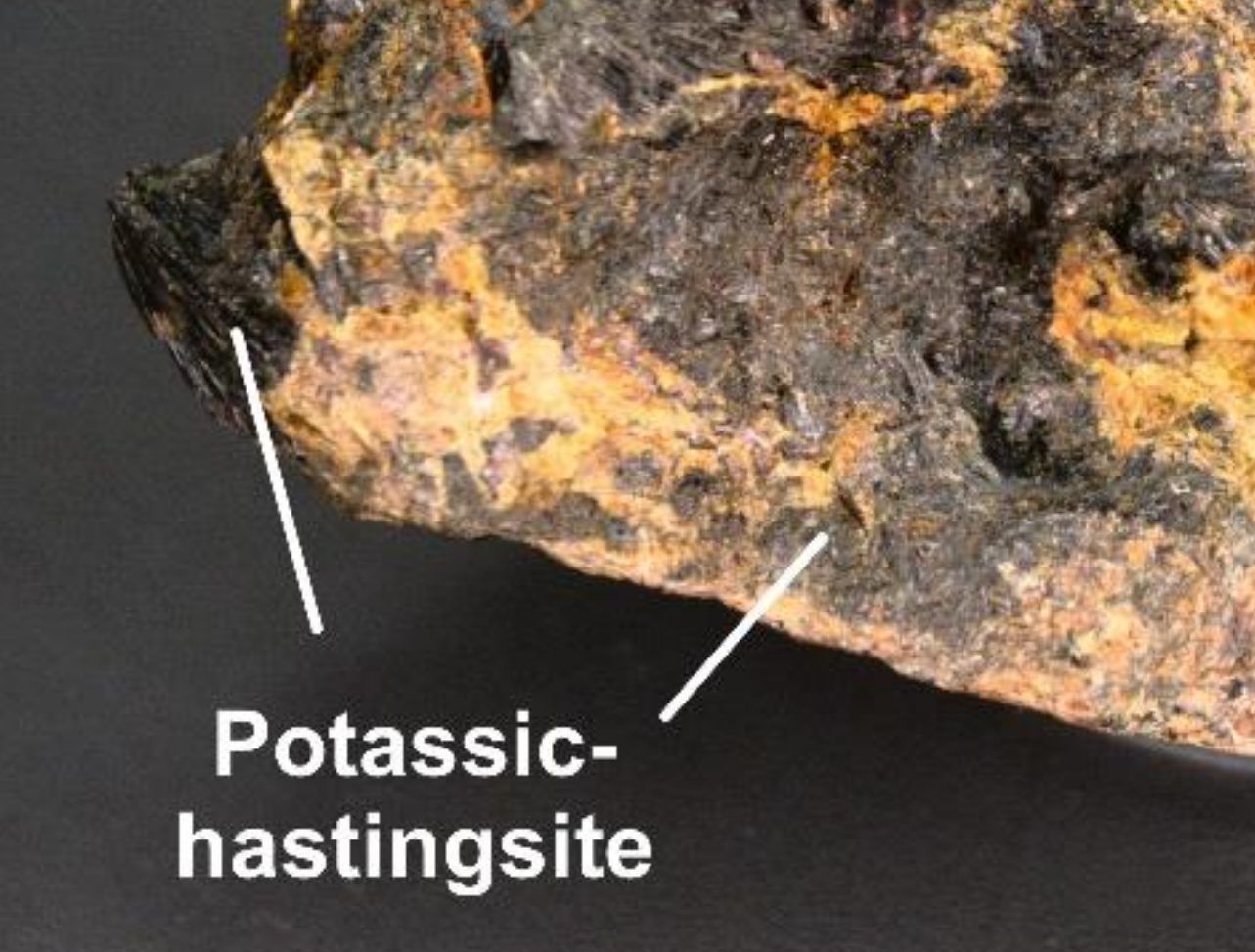
The sample is a rock fragment (7 cm × 4 cm × 3 cm), composed mainly of intergrowths and radial-radiant aggregates of dark green, almost black potassic-hastingsite, brown-orange garnet, purple vesuvianite, and small amounts of calcite, quartz, and sulfides. Apatite and zircon were identified as accessory minerals. Zoisite and epidote are found as single grains. Minerals are unevenly distributed. The structure is coarse-grained. From the Kedrovy District (East Siberia, Russia). The image is published in an open access article distributed under the terms and conditions of the Creative Commons Attribution (CC BY) license ( https://creativecommons.org/licenses/by/4.0/ ). — Photo: Kaneva, Ekaterina and Radomskaya, Tatiana and Shendrik, Roman and Chubarov, Victor and Danilovsky, Victoria · CC BY 4.0
Potassic-hastingsite
Potassic-hastingsite is an IMA-recognized mineral species in the silicate class, with the chemical formula KCa₂(Fe²⁺₄Fe³⁺)(Si₆Al₂)O₂₂(OH)₂.
It crystallizes in the monoclinic crystal system (space group C2/m). It is a member of the Amphibole structural group.
Key properties: Mohs hardness 5.5; specific gravity 3.51; Dark green streak; Vitreous luster; optically biaxial.
IMA symbol Phst, IMA status: approved, named in 2019.
Found in irregular, miarolitic, “hornblendite” veins cutting volcanic rocks.
It is found associated with K-rich hastingsite, potassic-chloro-hastingsite, quartz, biotite, zoisite, chlorite. Distribution From Danailingou, Tongxing town, Keshiketeng Banner.
The prefix identifies the K-dominant analogue of hastingsite.