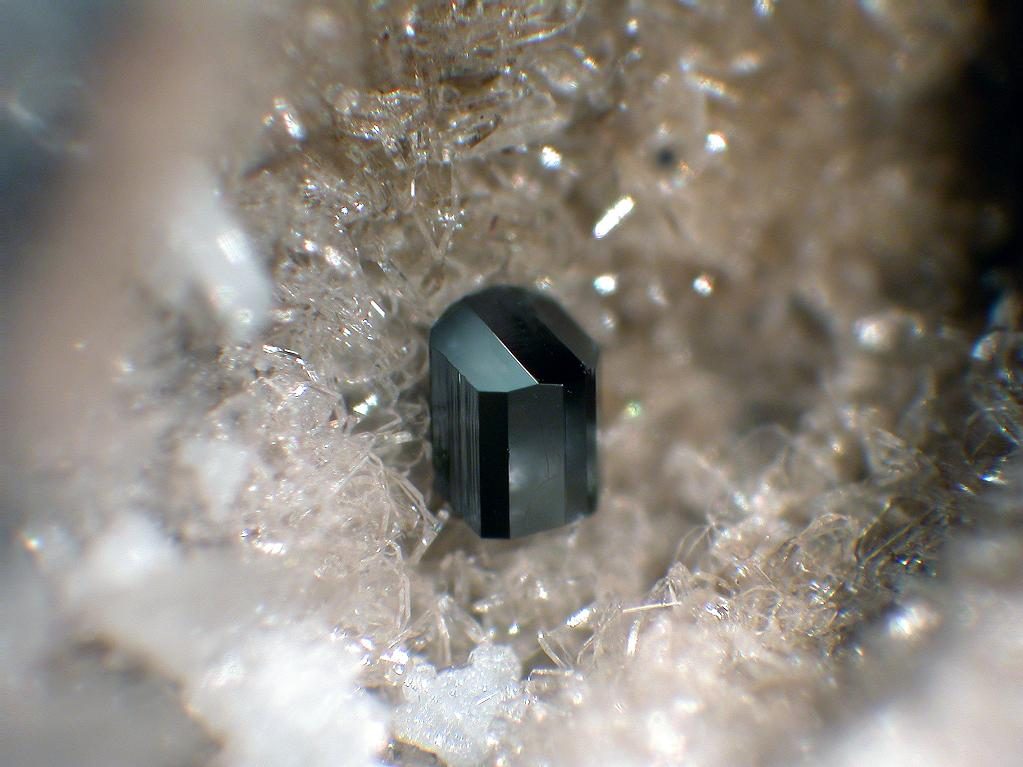
Pseudobrookite block (0,8mm) with many shining faces and the typical stripes on the left side - Locality: Wannenköpfe, Ochtendung, Eifel region, Germany — Photo: Fred Kruijen · CC BY-SA 3.0 nl
Pseudobrookite
An iron-titanium oxide of volcanic rocks and ore veins — black bladed crystals.
Intro adapted from Wikipedia (CC BY-SA).
Pseudobrookite is an IMA-recognized mineral species in the oxides & hydroxide class, with the chemical formula (Fe³⁺₂Ti)O₅.
It crystallizes in the orthorhombic crystal system (space group Cmcm). It is a member of the Pseudobrookite structural group.
Key properties: Mohs hardness 6; specific gravity 4.33–4.39; Reddish brown to ocher-yellow streak; Metallic adamantine, may be tarnished iridescent, greasy on fractures luster; refractive index 2.387; optically biaxial.
IMA symbol Pbrk, IMA status: approved, named in 1878.
Typically, formed by pneumatolytic processes in titanium-rich andesite, rhyolite, basalt, etc., and by reactions with xenoliths within these; in lithophysae. Rarely in plutonic rocks.
It is found associated with Hematite, magnetite, bixbyite, ilmenite, enstatite-ferrosilite, tridymite, quartz, sanidine, topaz, spessartine, beryl, mica, cassiterite, apatite.
Its name comes from the Greek for false and brookite, as it was for some time thought to be that mineral.