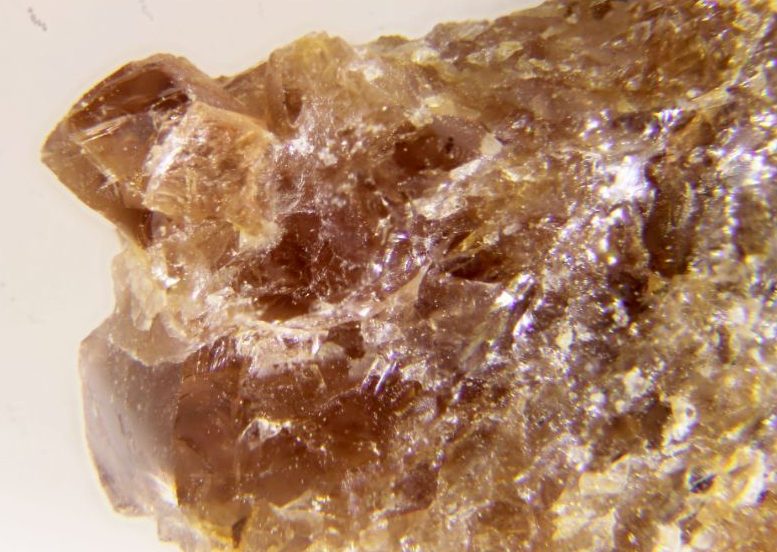
Orange brown crystal group of the very rare silicate mineral pyroxferroite from a little known locality in Japan (Isanago Mine, Ohro Kyotango City, Kyoto Prefecture, Honshu Island, Japan). Pyroxferroite has the big singularity of having its type locality in the Moon, exactly in the Sea of Tranquility, where the famous Neil Armstrong landed on July 20, 1969. Ex Vandenbroucke Museum collection from Waregem, Belgium. — Photo: David Hospital · CC BY-SA 4.0
Pyroxferroite
An iron-calcium pyroxenoid — one of the three minerals discovered on the Moon by Apollo 11.
Intro adapted from Wikipedia (CC BY-SA).
Pyroxferroite is an IMA-recognized mineral species in the silicate class, with the chemical formula Fe²⁺SiO₃.
It crystallizes in the triclinic crystal system (space group P-1).
Key properties: Mohs hardness 5; specific gravity 3.68–3.76; refractive index 1.758; optically biaxial.
IMA symbol Pxf, IMA status: approved, named in 1970.
Occurs as discrete grains in microgabbros or diabase (Sea of Tranquillity, Moon).
It is found associated with Clinopyroxene, plagioclase, ilmenite, cristobalite, tridymite, fayalite, fluorapatite, potassic feldspar (Sea of Tranquillity, Moon).
The name comes from PYROXene and FERROus iron, and for its relation to pyroxmangite.