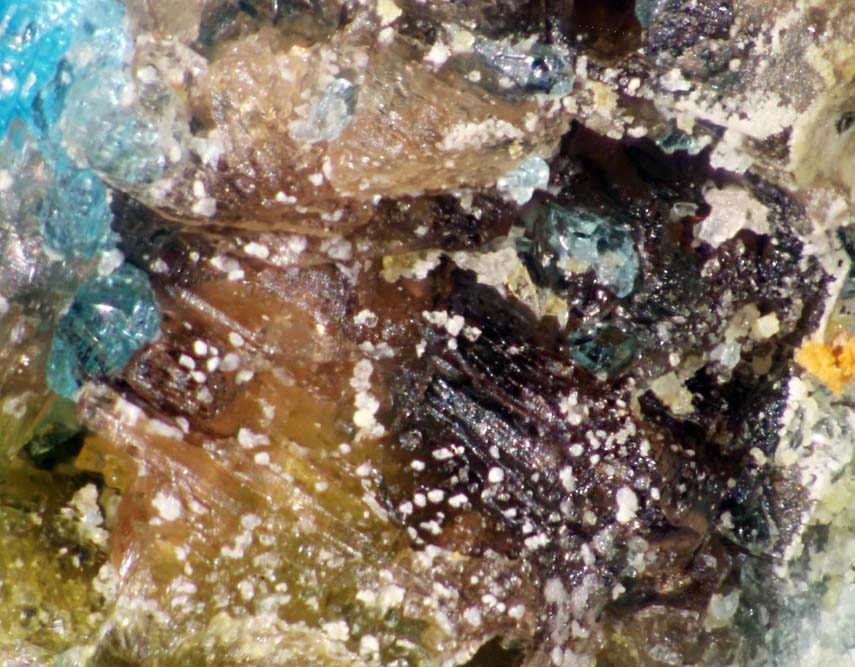
Pale violet crystals of the very rare sulphate mineral quenstedtite from this Chilean locality (Barranca del Sulfato, Mejillones, Antofagasta Region, Chile), associated to blue chalcanthite and yellow copiapite. — Photo: David Hospital · CC BY-SA 4.0
Quenstedtite
An uncommon violet-to-white hydrated iron sulfate of oxidized pyrite bodies in arid climates.
Intro adapted from Wikipedia (CC BY-SA).
Quenstedtite is an IMA-recognized mineral species in the sulfate class, with the chemical formula Fe³⁺₂(SO₄)₃·11H₂O.
It crystallizes in the triclinic crystal system (space group P-1).
Key properties: Mohs hardness 2.5; specific gravity 2.11–2.15; optically biaxial.
IMA symbol Qst, grandfathered status — known before the IMA’s founding, named in 1888.
An uncommon mineral formed in the oxidized zone of pyrite-rich mineral deposits especially in arid regions.
It is found associated with Coquimbite, copiapite, römerite.
The mineral was named to honor Professor Friedrich August Quenstedt (1809–1889), German mineralogist and paleontologist, University of Tübingen, Tübingen, Germany.