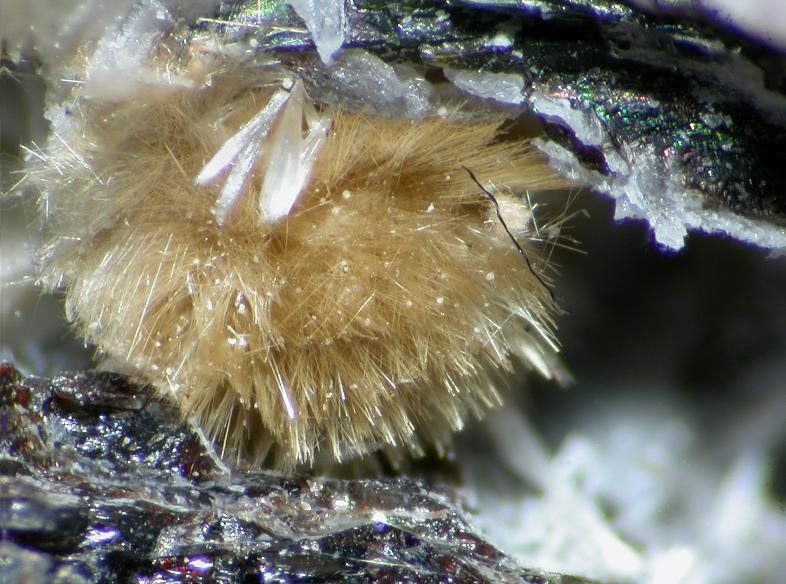
Raite , Zorite Locality: Yubileinaya (Yubileinoye; Jubilejnaja) pegmatite, Karnasurt Mt, Lovozero Massif, Kola Peninsula, Murmanskaja Oblast', Northern Region, Russia Golden-brown acicular Raite xls together with some white Zorite sprays. Field of view 4 mm. Specimen and photo Leon Hupperichs. — Photo: Leon Hupperichs · CC BY-SA 3.0
Raite
Raite is an IMA-recognized mineral species in the silicate class, with the chemical formula Na₃Mn²⁺₃Ti₀.₂₅(Si₈O₂₀)(OH)₂·10H₂O.
It crystallizes in the monoclinic crystal system (space group C2/m).
Key properties: Mohs hardness 3; specific gravity 2.32–2.39; Yellow streak; Vitreous, may be silky luster; optically biaxial.
IMA symbol Rai, IMA status: approved, named in 1972.
On the walls of fractures filled with nepheline in alkalic pegmatite in a differentiated alkalic massif (Lovozero massif, Russia).
It is found associated with Nepheline, aegirine, mountainite, natrolite, zorite (Lovozero massif, Russia); aegirine, albite, nepheline, sodalite, sérandite, analcime, ancylite.
The mineral was named to honor the scientists, led by Thor Heyerdahl, crewing the papyrus ship Ra (1969-1970).