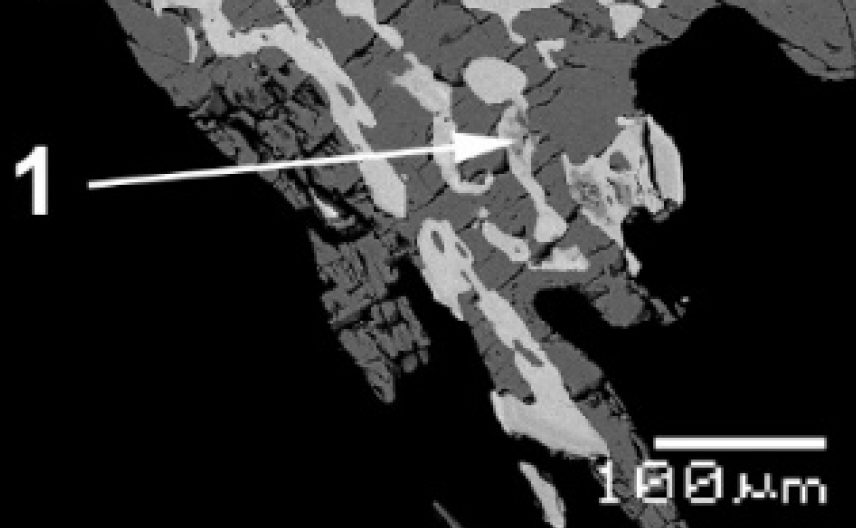
(Figure 2) Abundant skeletal, case-like coarse crystals of udinaite (light grey) embedded in anhydrite (dark grey matrix), with small grains of rhabdoborite-(V) (1). Polished section, SEM (BSE) image. The image is published in an open access article distributed under the terms and conditions of the Creative Commons Attribution (CC BY) license ( https://creativecommons.org/licenses/by/4.0/ ). — Photo: Pekov, Igor V. and Koshlyakova, Natalia N. and Zubkova, Natalia V. and Belakovskiy, Dmitry I. and Vigasina, Marina F. and Agakhanov, Atali A. and Ksenofontov, Dmitry A. and Turchkova, Anna G. and Britvin, Sergey N. and Sidorov, Evgeny G. and Pushcharovsky, Dmitry Yu. · CC BY-SA 4.0
Rhabdoborite-(V)
Rhabdoborite-(V) is an IMA-recognized mineral species in the borate class, with the chemical formula Mg₁₂(V⁵⁺,Mo⁶⁺,W⁶⁺)₁.₅O₆{[BO₃]₆₋ₓ[(P,As)O₄]ₓF₂₋ₓ} (x < 1).
It crystallizes in the hexagonal crystal system (space group P6_3). It is a member of the Rhabdoborite structural group.
Key properties: specific gravity 3.39; White streak; Vitreous luster; optically uniaxial.
IMA symbol Rbo-V, IMA status: approved, named in 2018.
A volcanic sublimate or, more probably, formed by the interaction between fumarolic gas and basalt scoria.
It is found associated with Rhabdoborite-(Mo), rhabdoborite-(W), anhydrite, diopside, hematite, schäferite, berzeliite, svabite, calciojohillerite, ludwigite, forsterite, magnesioferrite.
Refers to morphological (rhabdos is “rod”, in Greek) and chemical (borate) features of the mineral; a suffix indicates the dominant element as the M component.