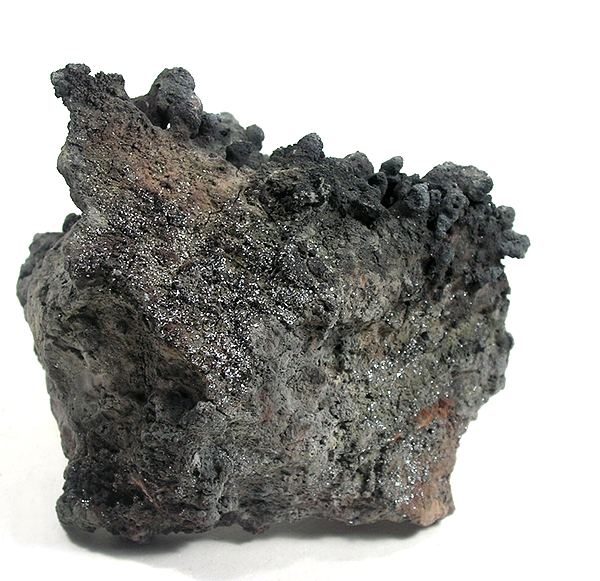
Rheniite Locality: Kudriavy (Kudryavyi) volcano, Iturup Island , Kuril Islands , Sakhalinskaya Oblast' , Far-Eastern Region, Russia ( Locality at mindat.org ) Rheniite is the only known mineral with Rhenium as its primary metallic constituent and as such is a fascinating species. It occurs at a volcanic vent in this remote area of Russia, and scientists have to climb down into hot crevasses to find the stuff. That being said, it is usually pretty ugly and massive material in terms of specimen appeal on the macro level. THIS piece, brought to my attention by my friend Dmitriy Belakovskiy of the Fersman Museum, has rheniite draped liberally on one side of the specimen and actual hardened rock made from the bubbly lava on the other! This shows the origins of the material so well, compared to most rather chunky specimens. Even aside from the lava, it is a really rich specimen with LOTS of bright microcrystalline rheniite. 8.9 x 7.8 x 7.7 cm — Photo: Robert M. Lavinsky · CC BY-SA 3.0
Rheniite
The only essentially-rhenium mineral — rhenium disulfide — metallic silver-gray triclinic plates.
Intro adapted from Wikipedia (CC BY-SA).
Rheniite is an IMA-recognized mineral species in the sulfide class, with the chemical formula ReS₂.
It crystallizes in the triclinic crystal system (space group P-1).
Key properties: specific gravity 7.598; Gray-black streak; Metallic luster.
IMA symbol Rhn, IMA status: approved, named in 1999.
Occurs as sublimates in high-temperature fumaroles and in porphyry-type Mo-Cu-Te-Ag-Au hydrothermal mineralization.
It is found associated with Molybdenite, pyrite, quartz (Pagoni Rachi); magnetite, corundum, wollastonite, andradite-grossular garnet, wurtzite, greenockite, cadmoindite.
The name refers to its chemical composition as a unique mineral of rhenium.