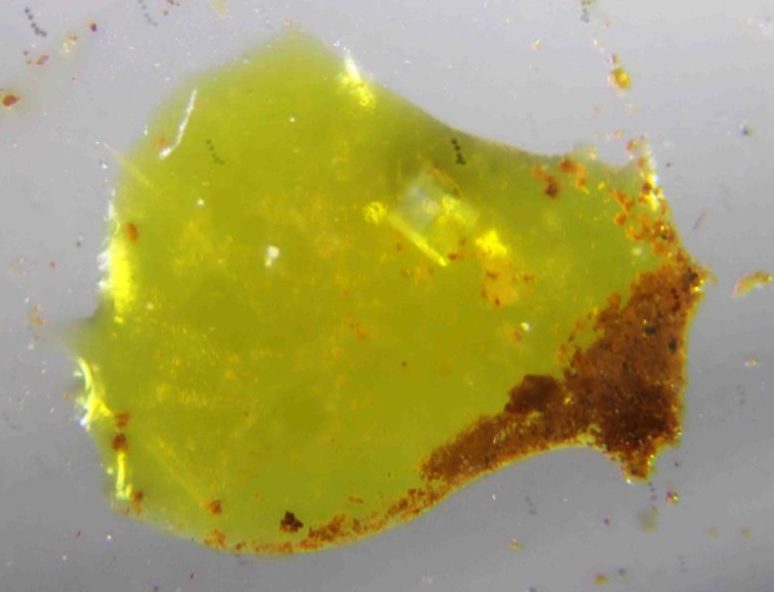
Yellow brown partially melted crystal of the very rare Fe chloride mineral rokühnite from the type locality in Hildesheim, Germany (Hildesheim, Lower Saxony, Germany). Analyzed specimen by SEM/EDS. The mineral species is very higroscopic, from Mindat: water-soluble; topotactical hydration and rapid oxidation in air. okuhnite is described as light green, but rapidly oxidizes and turns brown when exposed to air and moisture. Ex Vandenbroucke Museum collection from Waregem, Belgium. — Photo: David Hospital · CC BY-SA 4.0
Rokühnite
The rare mineral form of ferrous chloride — a fumarole encrustation named for Rokuhn.
Intro adapted from Wikipedia (CC BY-SA).
Rokühnite is an IMA-recognized mineral species in the halide class, with the chemical formula FeCl₂·2H₂O.
It crystallizes in the monoclinic crystal system (space group C2/m).
Key properties: specific gravity 2.35; optically biaxial.
IMA symbol Rok, IMA status: approved, named in 1979.
Found as a secondary mineral in fissures in earlier potassium-rich salt beds.
It is found associated with Carnallite, rinneite, halite, tachyhydrite, sylvite, langbeinite.
The mineral was named to honor Professor Dr. Robert Kühn (1911–), German mineralogist, Kaliforschungs-Institut der Kali und Salz AG, Hannover, Germany.