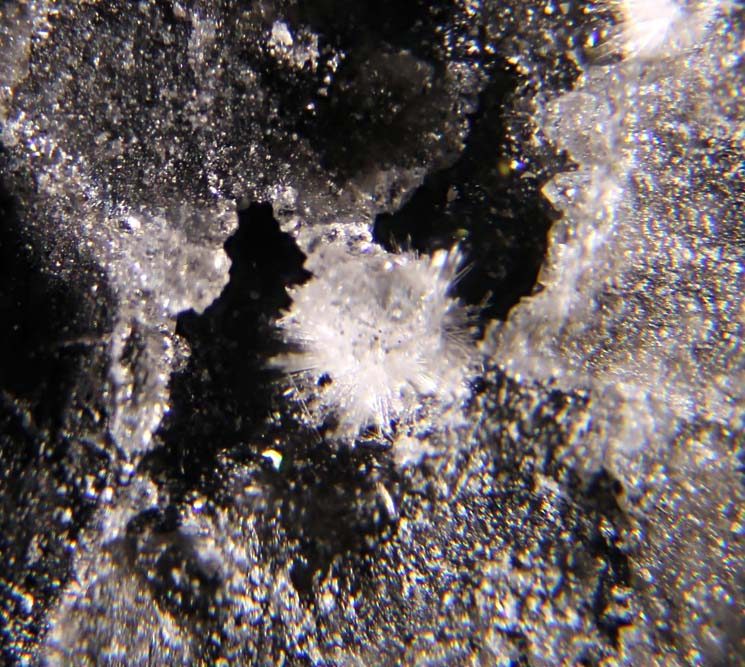
Colorless radial crystals of the very rare rosenbergite, a mineral of simple but curious chemistry since it is an aluminuim fluoride, AlF3·3H2O. Only 4 localities known worldwide, being this one the type locality: Le Cetine Mine, Siena, Tuscany, Italy. — Photo: David Hospital · CC BY-SA 4.0
Rosenbergite
Colorless hydrated aluminium fluoride — tetragonal crystals named for Philip Rosenberg.
Intro adapted from Wikipedia (CC BY-SA).
Rosenbergite is an IMA-recognized mineral species in the halide class, with the chemical formula AlF[F₀.₅(H₂O)₀.₅]₄·H₂O.
It crystallizes in the tetragonal crystal system (space group P4/n). It is a member of the Rosenbergite structural group.
Key properties: specific gravity 2.1; Vitreous luster; optically uniaxial.
IMA symbol Ros, IMA status: approved, named in 1992.
Very rare in cavities in a silicified limestone from an antimony deposit in highly silicified evaporites (Cetine mine, Italy); in volcanic sublimates (Mt. Erebus, Antarctica).
It is found associated with Gypsum, fluorite, elpasolite, ralstonite, onoratoite (Cetine mine, Italy).
The mineral was named to honor Professor Philip E. Rosenberg, Washington State University, Pullman, Washington, USA, who first noted the mineral in Antarctica.