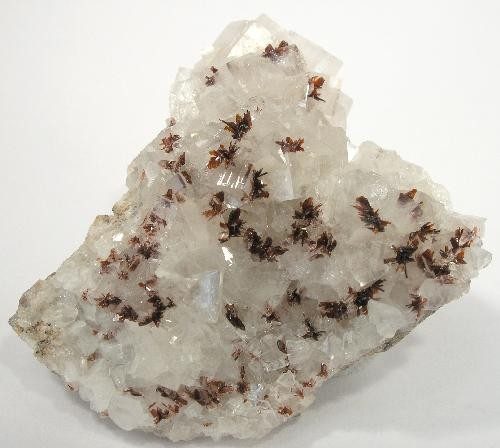
Ruizite , Calcite Locality: N'Chwaning Mines, Kuruman , Kalahari manganese fields, Northern Cape Province , South Africa ( Locality at mindat.org ) Size: 4 x 3.8 x 1.3 cm. A superb specimen of beautiful bladed crystals of the rare silicate Ruizite. The crystals, up to about 2 mm in length, grow in flower-like clusters liberally spread among the gemmy Calcite rhombs. The gemmy Ruizite blades have a deep cinnamon color and excellent luster. Ex. Charlie Key. — Photo: Robert M. Lavinsky · CC BY-SA 3.0
Ruizite
A calcium-manganese sorosilicate discovered at Arizona's Christmas mine in 1977, named for discoverer Joe Ana Ruiz.
Intro adapted from Wikipedia (CC BY-SA).
Ruizite is an IMA-recognized mineral species in the silicate class, with the chemical formula Ca₂Mn³⁺₂Si₄O₁₁(OH)₄·2H₂O.
It crystallizes in the monoclinic crystal system (space group P2_1/c). It is a member of the Ruizite structural group.
Key properties: Mohs hardness 5; specific gravity 2.9; Pale apricot streak; refractive index 1.704; optically biaxial.
IMA symbol Rz, IMA status: approved, named in 1977.
Found in veinlets and on fracture surfaces in metalimestones, developed during cooling of a high-temperature calc-silicate assemblage under oxidizing conditions (Christmas, Arizona, USA).
It is found associated with Apophyllite, kinoite, junitoite, wollastonite, grossular, diopside, vesuvianite, calcite, chalcopyrite, bornite, sphalerite, smectite (Christmas, Arizona.
The name refers to Joe Ana Ruiz, of Mammoth, Arizona, USA, collector of microscopic minerals, who discovered the mineral.