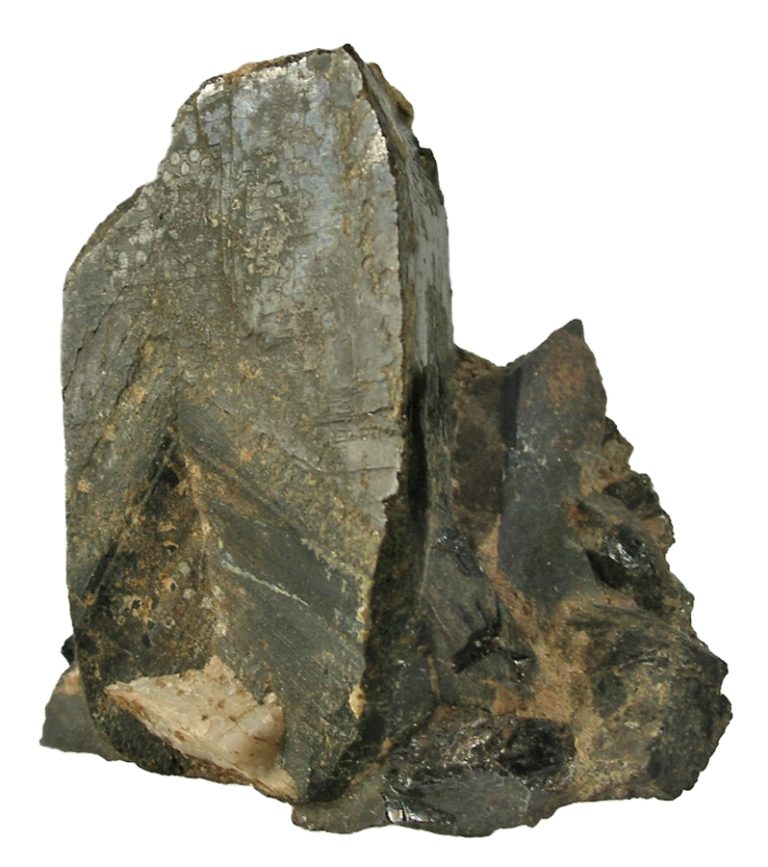
Samarskite-(Y) (Size: 4.6 x 4.6 x 3.0 cm) Locality: Setesdal, Aust-Agder, Norway A large, 3-dimensional, robust crystal of this very complex rare earth element containing species with niobium and tantalum in addition to uranium and other oddities mixed in. This is an older specimen, undoubtedly. Al obtained it in 1967 and it is labeled "Setesdal" although we cannot find a reference to this locality. It may instead be from a nearby and known location, as Setesdal seems to be a valley district and not a specific mine name. However, Bernard and Hyrsl’s “Minerals and their Localities” does include a listing for Setesdal. Ex. Al Ordway Collection. — Photo: Robert M. Lavinsky · CC BY-SA 3.0
Samarskite-(Y)
Samarskite is a radioactive rare earth mineral series which includes samarskite-(Y), with the chemical formula (YFe3+Fe2+U,Th,Ca)2(Nb,Ta)2O8 and samarskite-(Yb), with the chemical formula (YbFe3+)2(Nb,Ta)2O8. The formula for samarskite-(Y) is also given as (Y,Fe3+,U)(Nb,Ta)O4. Samarskite crystallizes in the orthorhombic – dipyramidal class as black to yellowish brown stubby prisms although it is typically found as anhedral masses. Specimens with a high uranium content are typically metamict and appear coated with a yellow brown earthy rind.
Intro adapted from Wikipedia (CC BY-SA).
Samarskite-(Y) is an IMA-recognized mineral species in the oxides & hydroxide class, with the chemical formula YFe³⁺Nb₂O₈.
It crystallizes in the monoclinic crystal system (space group P2/c). It is a member of the Samarskite structural group.
Key properties: Mohs hardness 5–6; specific gravity 5–5.69; Dark reddish brown to black, yellow-brown; gray when altered streak; Vitreous to resinous, may be submetallic, splendent; externally dull luster.
IMA symbol Smk-Y, IMA status: approved, named in 1847.
An accessory mineral in RE-rich granite pegmatites, common but not abundant; rarely as a detrital mineral.
It is found associated with Columbite, zircon, monazite, uraninite, aeschynite, magnetite, albite, topaz, beryl, garnet, muscovite, biotite.
The mineral was named to honor Colonel Vasilii Evgrafovich von Samarskii-Bykhovets (1803–1870), Chief of Staff of the Russian Corps of Mining Engineers.