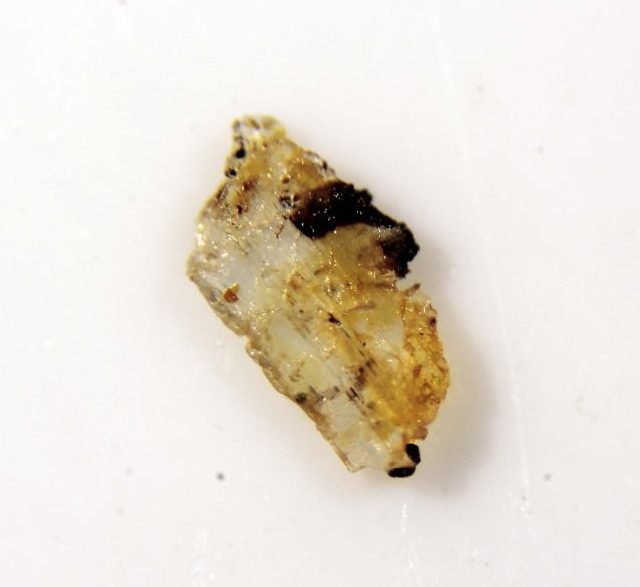
Outstanding yellow brown single crystal of the extremely rare Ca-Fe-Mn-Al phosphate from the TL in Palermo nº1 mine (Grafton County, New Hampshire, United States of America). Ex Vandenbroucke Museum collection from Waregem, Belgium. — Photo: David Hospital · CC BY-SA 4.0
Samuelsonite
A complex calcium-barium-manganese-aluminium phosphate of granite pegmatites, from North Groton, New Hampshire.
Intro adapted from Wikipedia (CC BY-SA).
Samuelsonite is an IMA-recognized mineral species in the phosphate class, with the chemical formula Ca₉Mn²⁺₄Al₂(PO₄)₁₀(OH)₂.
It crystallizes in the monoclinic crystal system (space group C2/m).
Key properties: Mohs hardness 5; specific gravity 3.24–3.35; Subadamantine, may be vitreous to resinous luster; refractive index 1.653; optically biaxial.
IMA symbol Sms, IMA status: approved, named in 1974.
Found as a secondary mineral in complex zoned granite pegmatites.
It is found associated with Childrenite, hydroxylapatite, arrojadite, whitlockite, carbonate-apatite, laueite, Fe–Mn oxides (Palermo #1 mine, New Hampshire, USA); trolleite, bertossaite.
The mineral was named to honor Peter B. Samuelson (1941–), Rumney, New Hampshire, USA, for his efforts in field collecting of pegmatite minerals.