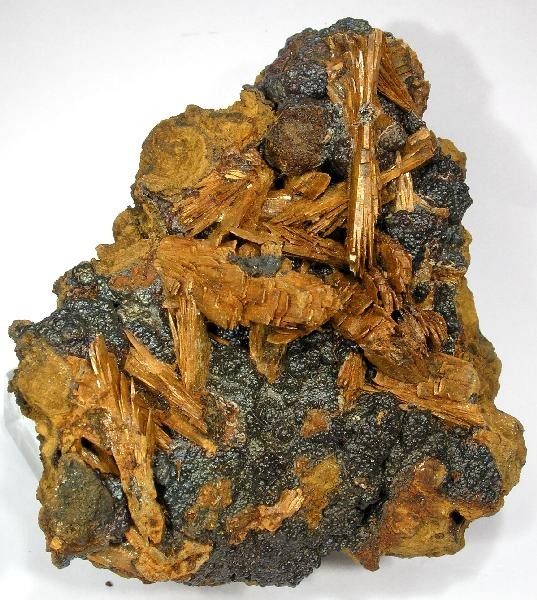
Santabarbaraite pseudomorph after Vivianite Locality: Kerch peninsula (Kertch peninsula), Crimea peninsula, Crimea Oblast', Ukraine ( Locality at mindat.org ) Size: 7 x 6.5 x 4.5 cm. It is easy to discern that these were once vivianite crystals by their bladed nature, some doubly terminated and 3.0 cm in length. They are now turned to a burnt-umber color by santabarbaraite, a rare hydrated iron phosphate. From the 1990s find. Ex. Martin Zinn Collection. — Photo: Robert M. Lavinsky · CC BY-SA 3.0
Santabarbaraite
An amorphous hydrated ferric phosphate discovered in Tuscany in 2000.
Intro adapted from Wikipedia (CC BY-SA).
Santabarbaraite is an IMA-recognized mineral species in the phosphate class, with the chemical formula Fe³⁺₃(PO₄)₂(OH)₃·5H₂O.
It crystallizes in the amorphous crystal system.
Key properties: specific gravity 2.42; Amber streak; Vitreous to greasy luster.
IMA symbol Sbb, IMA status: approved, named in 2000.
Found in cavities within concretionary nodules, in clays in a clastic rock sequence (Italy) and in clay underlying basalt (Australia). Formed in-situ by oxidation of Fe2+ in vivianite, progressing through metavivianite to santabarbaraite.
It is found associated with Vivianite, metavivianite, clay.
The name is derived from the locality in the Santa Barbara mining district of Tuscany, Italy, and for the Christian martyr Santa Barbara, the patron saint of miners.