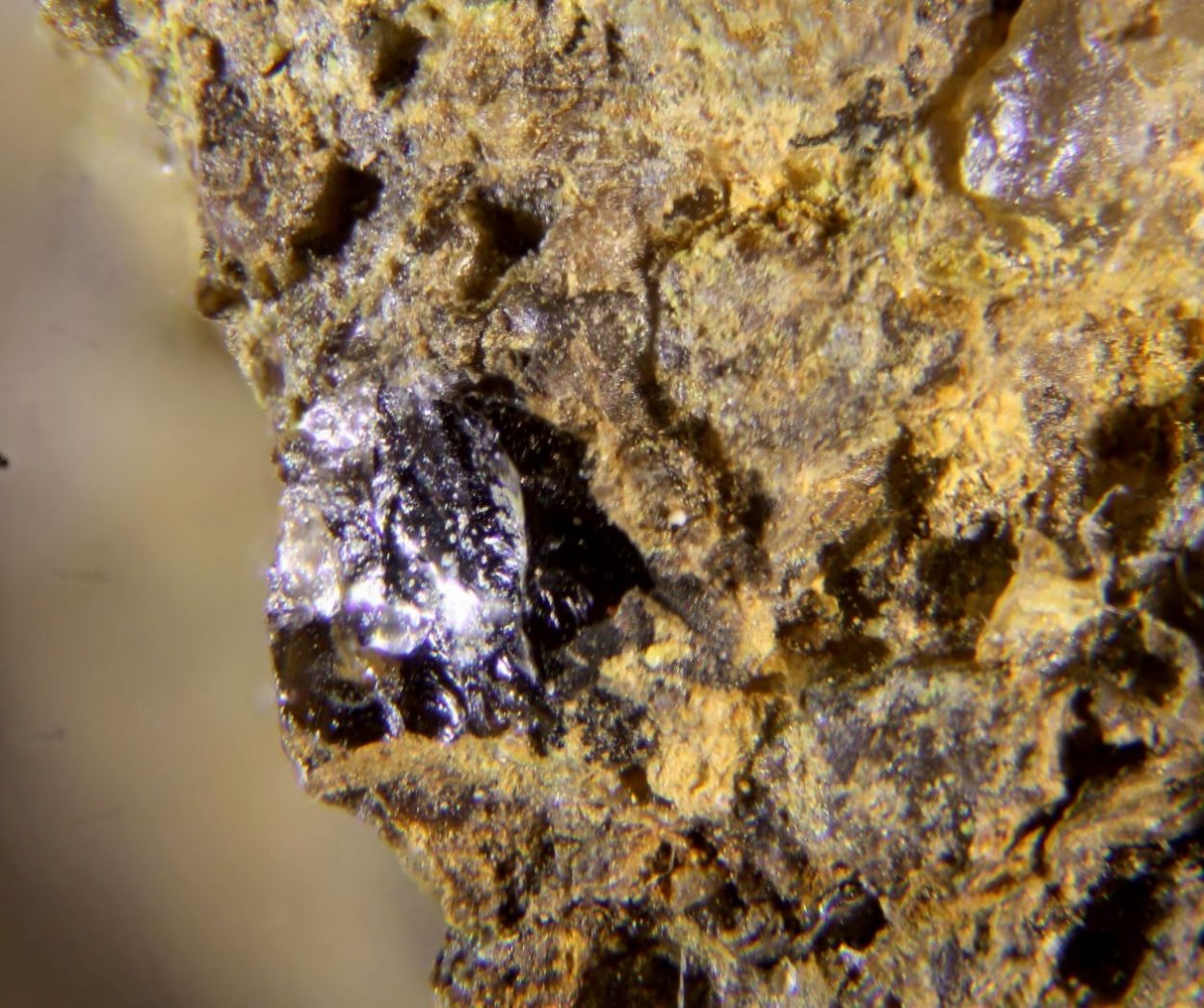
Brown crystals and crystal aggregates of the rare mineral santafeite from Arizona (Monument Valley, Apache County, Arizona, United States of America). Ex Vandenbroucke Museum collection specimen, from Waregem, Belgium. — Photo: David Hospital · CC BY-SA 4.0
Santafeite
Santafeite is an IMA-recognized mineral species in the vanadate class, with the chemical formula (Ca,Sr,Na)₃(Mn²⁺,Fe³⁺)₂Mn⁴⁺₂(VO₄)₄(OH,O)₅·2H₂O.
It crystallizes in the orthorhombic crystal system.
Key properties: specific gravity 3.379; Brown streak; Subadamantine luster; optically biaxial.
IMA symbol Sfe, grandfathered status — known before the IMA’s founding, named in 1958.
Rarely incrusting fractures in limestone (Grants district, New Mexico, USA) and in sandstone (Monument No. 1 mine, Arizona, USA) in Colorado Plateau-type U–V deposits.
It is found associated with Calcite, cuprosklodowskite (Grants district, New Mexico, USA); carnotite (Monument No. 1 mine, Arizona, USA).
The name refers to the Atchison, Topeka, and Santa Fe Railroad, on whose property the mineral was first found to occur, for their pioneering work in developing the uranium resources of the district.