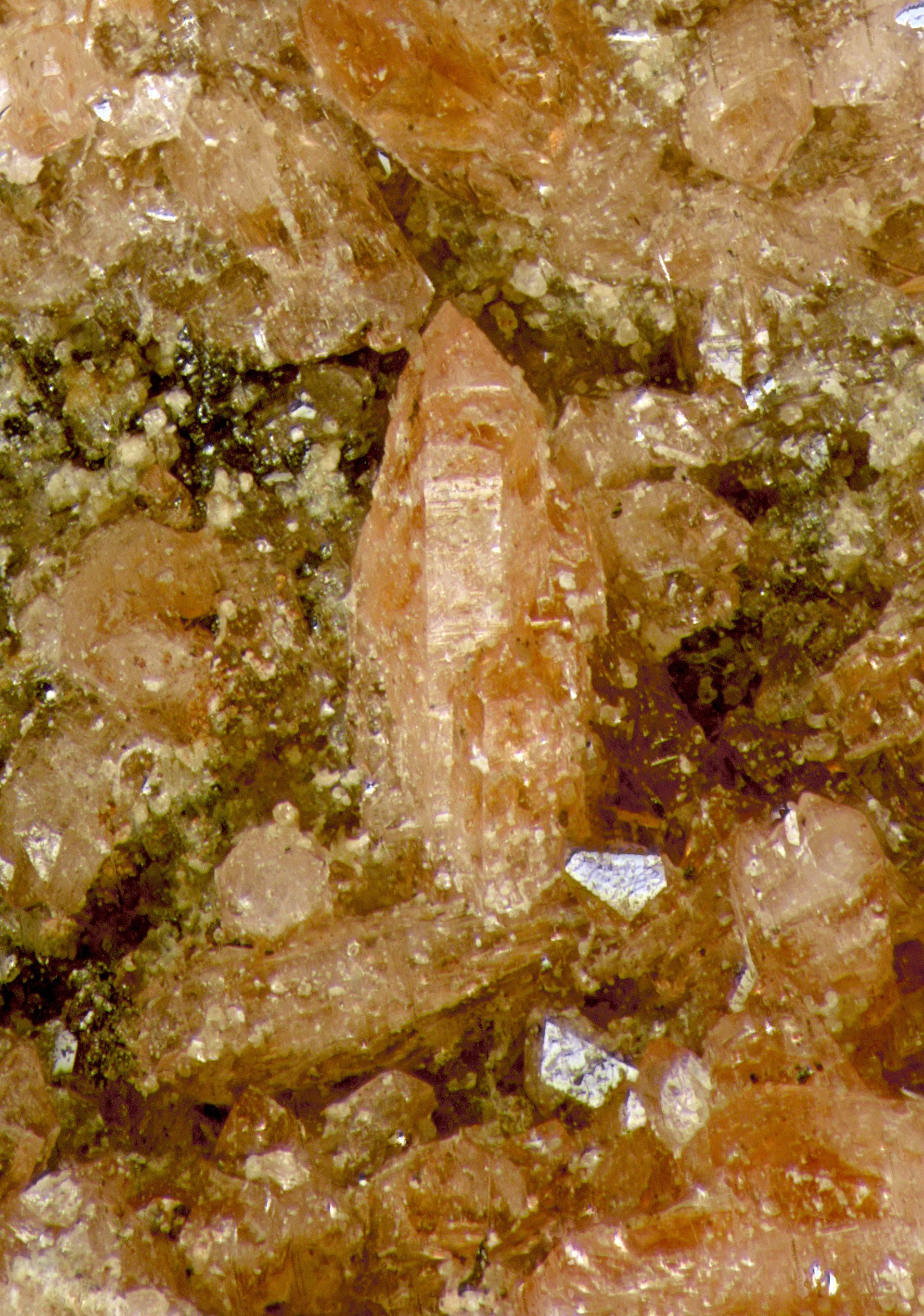
Sarkinite Locality: Sterling Mine, Sterling Hill, Ogdensburg, Sussex County, New Jersey, USA Description: This is a photo showing another of the larger (1⅔ mm) crystals on the specimen. — Photo: Modris Baum · Public domain
Sarkinite
A red, greasy-luster manganese arsenate — 'made of flesh' in Greek — also known as chondrarsenite.
Intro adapted from Wikipedia (CC BY-SA).
Sarkinite is an IMA-recognized mineral species in the arsenate class, with the chemical formula Mn²⁺₂(AsO₄)(OH).
It crystallizes in the monoclinic crystal system (space group P2_1/a). It is a member of the Wagnerite structural group.
Key properties: Mohs hardness 4–5; specific gravity 4.08–4.18; Rose-red to yellow streak; Greasy luster; refractive index 1.803; optically biaxial.
IMA symbol Srk, grandfathered status — known before the IMA’s founding, named in 1885.
Rare in metamorphosed Fe–Mn orebodies (Sweden); in manganese-rich lenses in quartzitic chlorite schists probably of marine origin (Ködnitz Valley, Austria); in metamorphosed stratiform zinc orebodies (New Jersey, USA).
It is found associated with Lead, bementite, brandtite, calcite, barite (Harstigen mine, Sweden); katoptrite, magnetite, jacobsite, tephroite (Sjö mine, Sweden); tephroite, pyroxmangite.
Its name comes from the Greek for made of flesh, an allusion to the blood-red color and greasy luster.