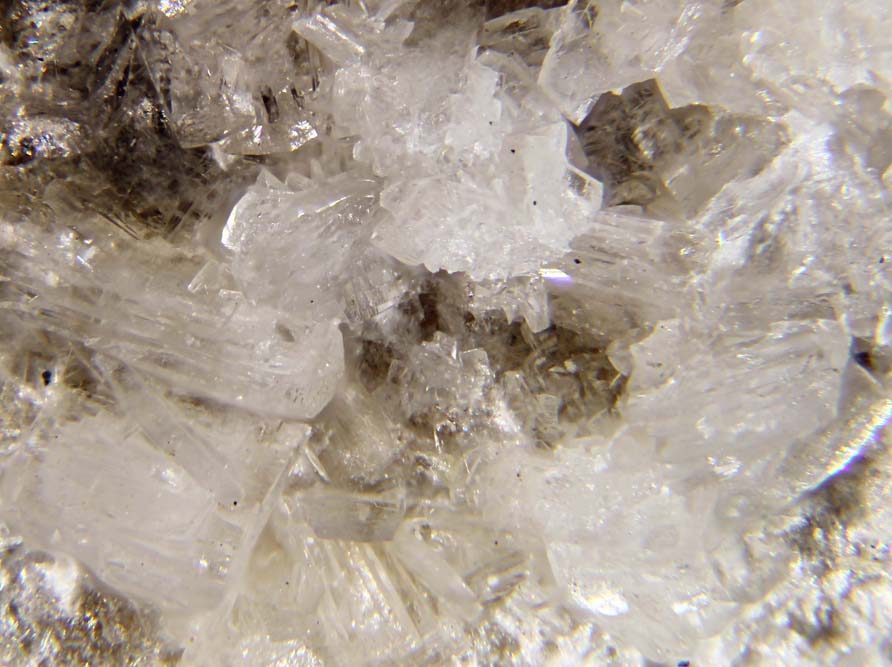
Outstanding colorless scawtite crystals from the well known locality of Crestmore (Crestmore Quarries, Riverside County, California, United States of America). Ex. Merrill collection and Ex. Mineral Zone specimen. — Photo: David Hospital · CC BY-SA 4.0
Scawtite
A hydrous calcium silicate-carbonate forming thin monoclinic plates, described in 1929 from Scawt Hill, Northern Ireland.
Intro adapted from Wikipedia (CC BY-SA).
Scawtite is an IMA-recognized mineral species in the silicate class, with the chemical formula Ca₇(Si₃O₉)₂(CO₃)·2H₂O.
It crystallizes in the monoclinic crystal system (space group Cm).
Key properties: Mohs hardness 4.5–5; specific gravity 2.71; Vitreous luster; optically biaxial.
IMA symbol Scw, grandfathered status — known before the IMA’s founding, named in 1930.
A late-stage hydrothermal mineral veining skarns formed from contact metamorphism of limestone.
It is found associated with Melilite, spurrite, tobermorite, thomsonite, larnite, grossular, bultfonteinite, calcite, analcime, foshagite, hillebrandite.
The name is derived from the locality where first found, Scawt Hill, Ireland.