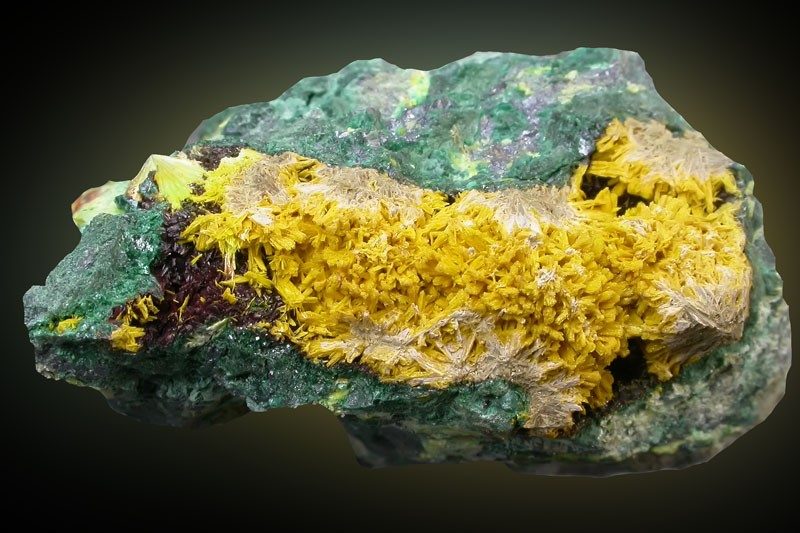
Schoepite , Rutherfordine Locality: Musonoi Mine, Kolwezi , Western area, Katanga Copper Crescent, Katanga (Shaba) , Democratic Republic of Congo (Zaïre) ( Locality at mindat.org ) Size: 4.5 x 2.4 x 2.7 cm. A very good example of this classic mineral from the Musonoi Mine. Most specimens are TN’s but this is a larger size. Note the nicely formed crystals where the inner core of Rutherfordine can still be seen. This specimen was recovered during the removal of the U-dump in the early 1990’s. Musonoi has ceased producing minerals since then. Nothing has come out of Katanga for more than 15 years, except for Malachite and Chrysocolla. — Photo: Robert M. Lavinsky · CC BY-SA 3.0
Schoepite
A transparent-to-translucent yellow uranyl hydroxide — a common alteration product of uraninite.
Intro adapted from Wikipedia (CC BY-SA).
Schoepite is an IMA-recognized mineral species in the oxides & hydroxide class, with the chemical formula (UO₂)₄O(OH)₆(H₂O)₆.
It crystallizes in the orthorhombic crystal system (space group P2_1ca). It is a member of the Schoepite structural group.
Key properties: Mohs hardness 2.5; specific gravity 4.8–4.96; Yellow streak; Adamantine luster; refractive index 1.713; optically biaxial.
IMA symbol Sho, IMA status: approved, named in 1923.
A rare alteration product of uraninite in hydrothermal uranium deposits; can form directly from ianthinite.
It is found associated with Uraninite, becquerelite, billietite, vandendriesscheite, fourmarierite, ianthinite, curite, soddyite, rutherfordine, uranophane (Shinkolobwe, Congo).
The mineral was named to honor Alfred Schoep (1881–1966), Professor of Mineralogy, University of Ghent, Ghent, Belgium, for his contributions to uranium mineralogy.