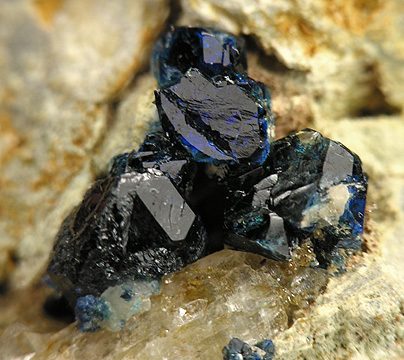
Scorzalite Locality: Estaño Orcko mine (Estaño Orkho mine), Machacamarca District (Colavi District), Cornelio Saavedra Province , Potosí Department , Bolivia ( Locality at mindat.org ) Size: 6.8 x 5.7 x 5.1 cm. Recently some very impressive and attractive specimens of Scorzalite were found at the Estaño Orcko mine in Bolivia. For some time these specimens were thought to be Lazulite, but Brian Kosnar was the one who first reported (through analysis) that they are indeed Scorzalite (the iron analogue of Lazulite). For the size, luster and overall quality of the crystals, they are certainly some of the best Scorazlites to reach the market in a very long time. This particular specimen hosts a few sharp, very lustrous, deep inky-blue color, monoclinic crystals of Scorzalite measuring up to 3 mm on matrix. — Photo: Robert M. Lavinsky · CC BY-SA 3.0
Scorzalite
The dark-blue iron end of the lazulite-scorzalite phosphate series.
Intro adapted from Wikipedia (CC BY-SA).
Scorzalite is an IMA-recognized mineral species in the phosphate class, with the chemical formula Fe²⁺Al₂(PO₄)₂(OH)₂.
It crystallizes in the monoclinic crystal system (space group P2_1/c). It is a member of the Lazulite structural group.
Key properties: Mohs hardness 6; specific gravity 3.33; White to pale blue streak; Vitreous luster; refractive index 1.657; optically biaxial.
IMA symbol Scz, grandfathered status — known before the IMA’s founding, named in 1949.
Typically a secondary mineral in complex zoned granite pegmatites; can occur in kyanite-rich quartzite.
It is found associated with Souzalite, triphylite, wyllieite, trolleite, apatite, lacroixite, berlinite, tourmaline, muscovite, feldspar, quartz.
The mineral was named to honor Dr. Evaristo Pena Scorza (1899–?), Chief Mineralogist, Mineral Survey of Brazil, Rio de Janeiro, Brazil.