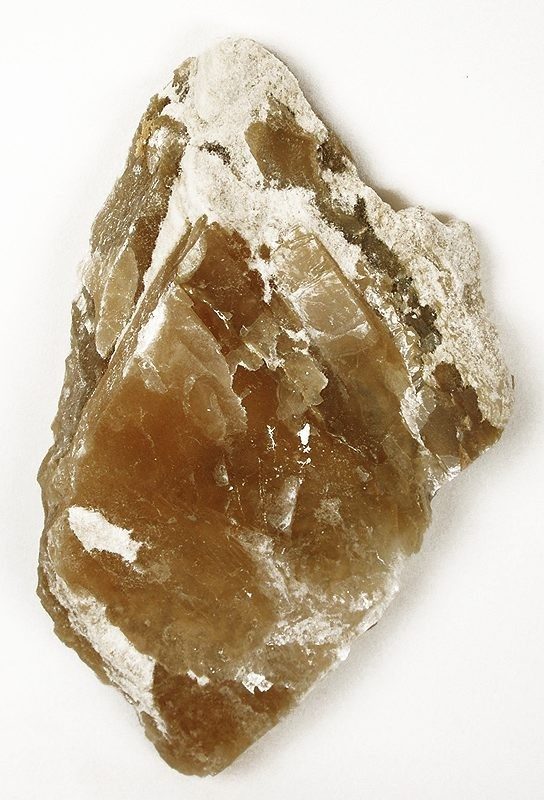
Searlesite Locality: Westvaco mine, Green River formation , Sweetwater County , Wyoming , USA ( Locality at mindat.org ) Size: 11.3 x 7.2 x 1.8 cm. This is a huge crystal for the species, showing an 8 cm-tall sub-termination leading up to the main termination above. These are giants for the species and it is an attractive specimen. It is coated in some edges by another white, powdery mineral species (perhaps norsethite but not yet tested). Ex. Smithsonian and Academy of Natural Sciences Philadelphia Collections. — Photo: Robert M. Lavinsky · CC BY-SA 3.0
Searlesite
A sodium borosilicate discovered in 1914 at Searles Lake, California.
Intro adapted from Wikipedia (CC BY-SA).
Searlesite is an IMA-recognized mineral species in the silicate class, with the chemical formula NaBSi₂O₅(OH)₂.
It crystallizes in the monoclinic crystal system (space group P2_1).
Key properties: Mohs hardness 3.5; specific gravity 2.44–2.46; Vitreous, slightly pearly on cleavage surfaces luster; refractive index 1.527; optically biaxial.
IMA symbol Sle, grandfathered status — known before the IMA’s founding, named in 1914.
Commonly interbedded with oil shales or marls (Green River Formation, USA); in boron-bearing evaporite deposits (California, USA); rarely in vugs in phonolite (Point of Rocks, New Mexico, USA).
It is found associated with Shortite, trona, pyrite (Green River Formation, USA); \opal" (Cave Springs Wash, Nevada, USA).
The mineral was named to honor John W. Searles, who put down the deep well from which type material was extracted.