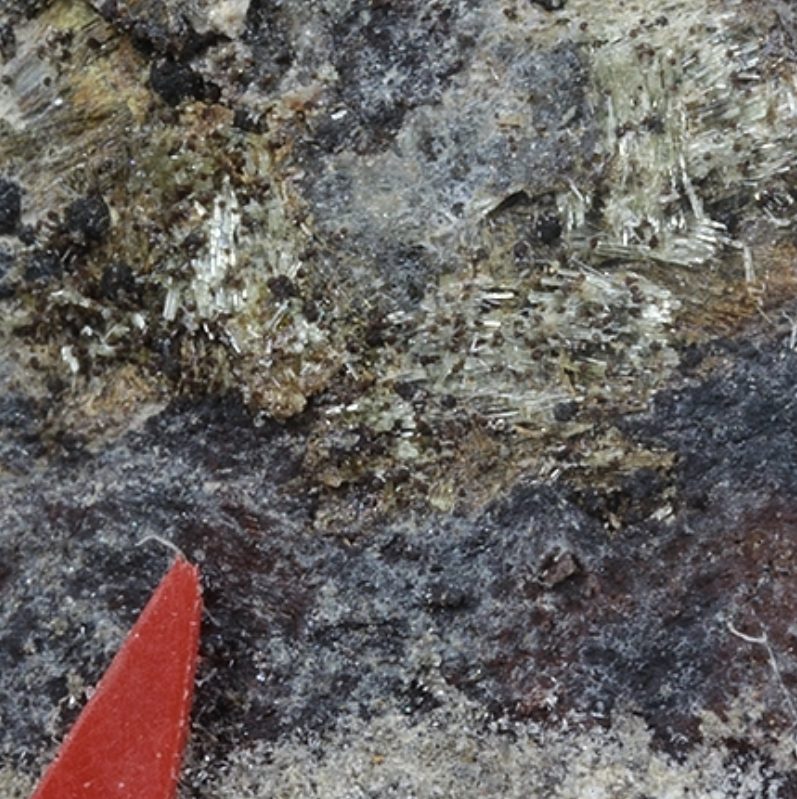
5.2 x 3.6 x 3.3 cm. This material is rarely available, and the species itself is only found in three places in the world. The phosphate species segelerite was approved in 1973, and the best examples are found at the Tip Top Mine to the best of my knowledge. This piece features tiny pale yellow "needle"-like crystals of segelerite on host rock matrix. A micro specimen to be sure, as the crystals are tiny, but really cool to view under the microscope. I'm told that this material hasn't been available for many years. Ex. Paolo Matioli Collection. — Photo: Robert M. Lavinsky · CC BY-SA 3.0
Segelerite
A chartreuse-green calcium-magnesium-iron phosphate discovered in 1974 in South Dakota's Black Hills pegmatites.
Intro adapted from Wikipedia (CC BY-SA).
Segelerite is an IMA-recognized mineral species in the phosphate class, with the chemical formula CaMgFe³⁺(PO₄)₂(OH)·4H₂O.
It crystallizes in the orthorhombic crystal system (space group Pbca). It is a member of the Overite structural group.
Key properties: Mohs hardness 4; specific gravity 2.67; Vitreous luster; optically biaxial.
IMA symbol Sgl, IMA status: approved, named in 1973.
A rare alteration product of triphylite in zoned complex granite pegmatites.
It is found associated with Ferrisicklerite-rockbridgeite, collinsite, hydroxylapatite, robertsite (Tip Top mine, South Dakota, USA).
The mineral was named to honor Curt George Segeler (1901–1989), American engineer and amateur mineralogist, Brooklyn, New York, USA.