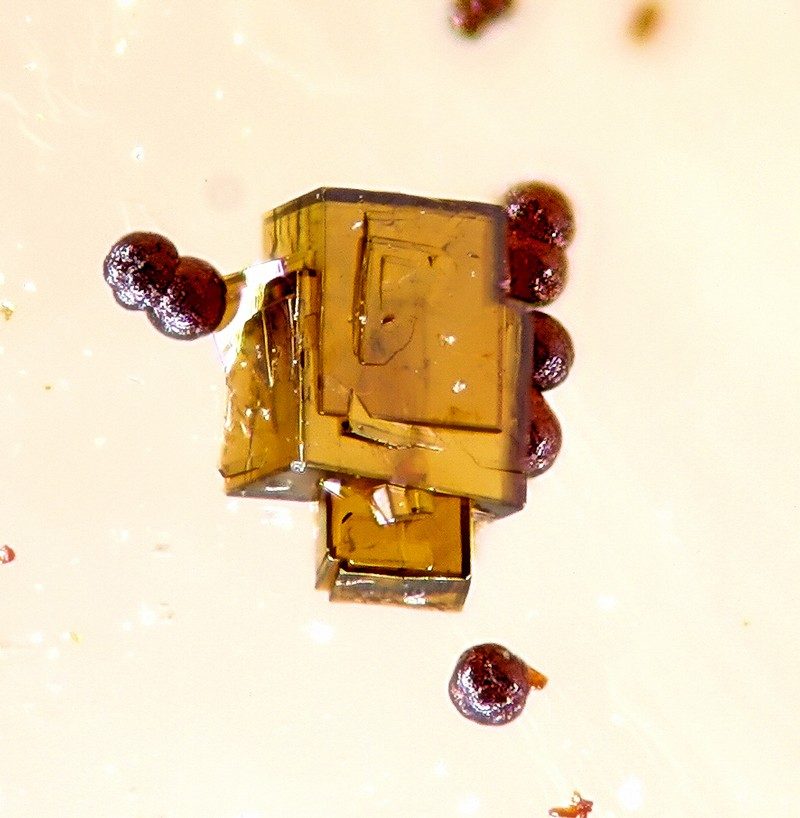
Segnitite , Lepidocrocite Locality: Alto das Quelhas do Gestoso Mines, Gestoso, Manhouce, São Pedro do Sul, Viseu District, Portugal Picture width 1 mm. Collection and photograph Christian Rewitzer Yellowbrown Segnitite (analysed !) with redbrown Lepidocrocite. — Photo: Christian Rewitzer · CC BY-SA 3.0
Segnitite
A lead-iron arsenate first found at Broken Hill, Australia — approved in 1991.
Intro adapted from Wikipedia (CC BY-SA).
Segnitite is an IMA-recognized mineral species in the arsenate class, with the chemical formula PbFe³⁺₃(AsO₄)(AsO₃OH)(OH)₆.
It is a member of the Alunite-crandallite structural group.
Key properties: Mohs hardness 4; specific gravity 4.2; Pale yellow streak; Vitreous to adamantine luster; optically uniaxial.
IMA symbol Sgt, IMA status: approved, named in 1991.
Of rare occurrence in the oxidized zone of a Pb–Zn orebody (Broken Hill, Australia); in a dolostone-hosted hydrothermal polymetallic ore deposit (Tsumeb, Namibia).
It is found associated with Beudantite–corkite, adamite–olivenite, duftite, bayldonite, carminite, mimetite, hidalgoite, pharmacosiderite, mawbyite, agardite-(Y), spessartine, quartz.
The mineral was named to honor Dr. E. Ralph Segnit (1923–1999), mineralogist and petrologist, University of Adelaide, Adelaide, Australia, for his contributions to Australian mineralogy.