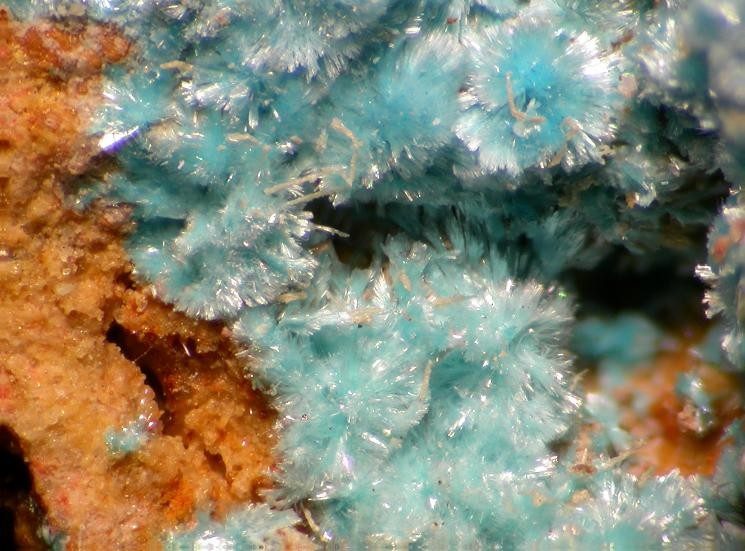
Serpierite Locality: Genna zinc smelter (slag locality), Letmathe, Iserlohn, Sauerland, North Rhine-Westphalia, Germany Field of view 4 mm. Specimen and photo Leon Hupperichs. — Photo: Leon Hupperichs · CC BY-SA 3.0
Serpierite
Serpierite (Ca(Cu,Zn)4(SO4)2(OH)6·3H2O) is a rare, sky-blue coloured hydrated sulfate mineral, often found as a post-mining product. It is a member of the devilline group, which has members aldridgeite (Cd,Ca)(Cu,Zn)4(SO4)2(OH)6·3H2O, campigliaite Cu4Mn2+(SO4)2(OH)6·4H2O, devilline CaCu4(SO4)2(OH)6·3H2O, kobyashevite Cu5(SO4)2(OH)6·4H2O, lautenthalite PbCu4(SO4)2(OH)6·3H2O and an unnamed dimorph of devilline. It is the calcium analogue of aldridgeite and it is dimorphous with orthoserpierite CaCu4(SO4)2(OH)6·3H2O.
Intro adapted from Wikipedia (CC BY-SA).
Serpierite is an IMA-recognized mineral species in the sulfate class, with the chemical formula Ca(Cu,Zn)₄(SO₄)₂(OH)₆·3H₂O.
It crystallizes in the monoclinic crystal system (space group C2/c). It is a member of the Devilline structural group.
Key properties: specific gravity 3.07; Vitreous, pearly on cleavages luster; refractive index 1.623; optically biaxial.
IMA symbol Spe, grandfathered status — known before the IMA’s founding, named in 1881.
Found as a secondary mineral in the oxidized zone of hydrothermal Cu–Zn-bearing hydrothermal mineral deposits; commonly a post-mine product.
It is found associated with Smithsonite, devilline, posnjakite, ktenasite, linarite, langite, brochantite, wroewolfeite, namuwite, schulenbergite, hydrozincite, malachite, gypsum.
The mineral was named to honor Giovanni Battista Serpieri (1832–1897), Italian engineer, who helped to reopen the ancient mines at Laurium, Greece.