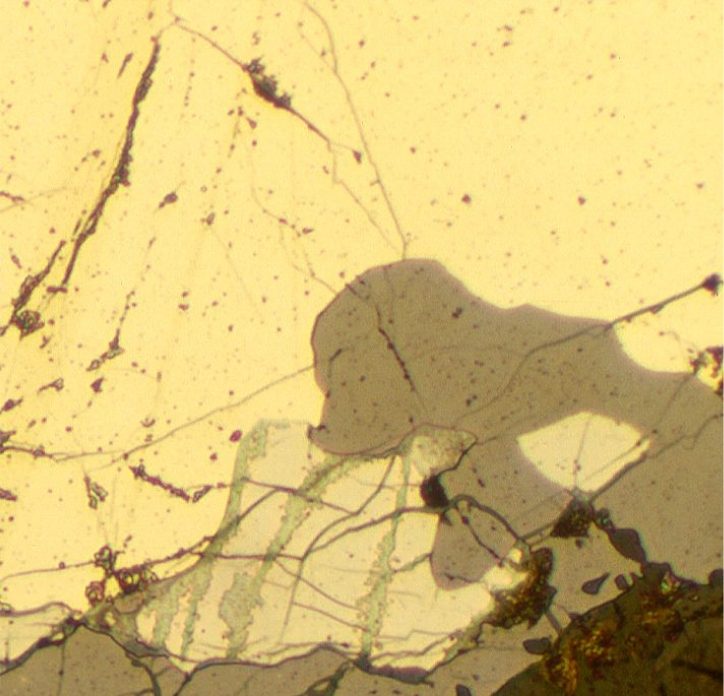
Shandite , Heazlewoodite , Sphalerite Field of view ≈ 0.4mm Locality: Nickel Reward Mine, Trial Harbour district, West Coast municipality, Tasmania, Australia Original description: Polished section of nickel ore, Nickel reward mine, Trial Harbour. Yelllow mineral is heazlewoodite, grey is sphalerite, and off-white is shandite (with some unidentified alteration). — Photo: Ralph Bottrill · CC BY 3.0
Shandite
A nickel-lead sulfide discovered in 1948 and named for Scottish petrologist Samuel Shand.
Intro adapted from Wikipedia (CC BY-SA).
Shandite is an IMA-recognized mineral species in the sulfide class, with the chemical formula Ni₃Pb₂S₂.
It crystallizes in the hexagonal crystal system (space group R-3m).
Key properties: Mohs hardness 4; specific gravity 8.72; Metallic luster.
IMA symbol Snd, grandfathered status — known before the IMA’s founding, named in 1949.
Found in serpentine (Trial Harbour, Australia and Isua Belt, Greenland); in segregations in an iron-rich lens in basalt (Kitdlı̂t, Greenland).
It is found associated with Heazlewoodite, pentlandite, sphalerite, chromite, magnetite (Trial Harbour, Australia); galena, altaite, lead, iron, troilite (Kitdlı̂t, Greenland).
The mineral was named to honor the Scottish petrologist, Professor Samuel James Shand (1882–1957), of Columbia University, New York, USA.