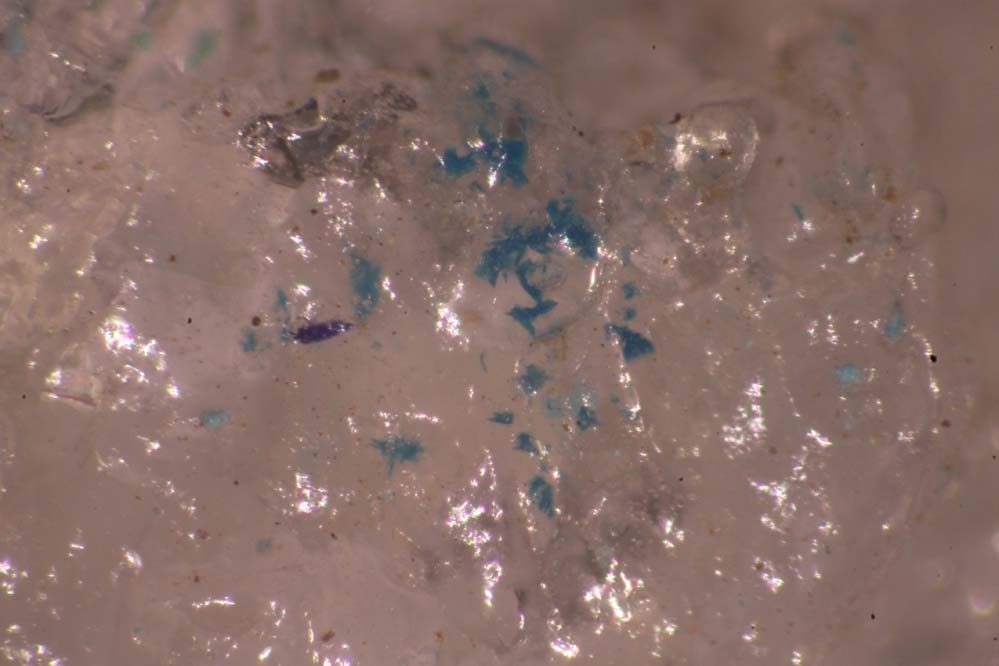
Shilovite is a new mineral from 2014 (IMA 2014-016) with an unusual composition, Cu(NH3)4(NO3)2, since it contains ammine groups, that is very unusual in minerals. It occurs in this specimen as violet microcrystals associated to majoritary sky blue ammineite (another new mineral with also ammine groups, IMA 2008-032) in a matrix of halite. From: Pabellon de Pica, Chanabaya, Iquique Province, Tarapacá Region, Chile. — Photo: David Hospital · CC BY-SA 4.0
Shilovite
Shilovite is an IMA-recognized mineral species in the nitrate class, with the chemical formula Cu(NH₃)₄(NO₃)₂.
It crystallizes in the orthorhombic crystal system (space group Pnn2).
Key properties: Mohs hardness 2; specific gravity 1.92; Violet-blue (changes to light blue with decomposition) streak; Vitreous luster; optically biaxial.
IMA symbol Shil, IMA status: approved, named in 2014.
Found in a guano deposit developed on chalcopyrite-bearing gabbro in a desert climate.
It is found associated with Halite, ammineite, atacamite (a product of ammineite alteration), thénardite.
The mineral was named to honor Alexander Evgen’evich Shilov (1930-2014), Russian chemist and Academician of the Russian Academy of Sciences, a specialist in biomimetics and the chemistry of nitrogen.