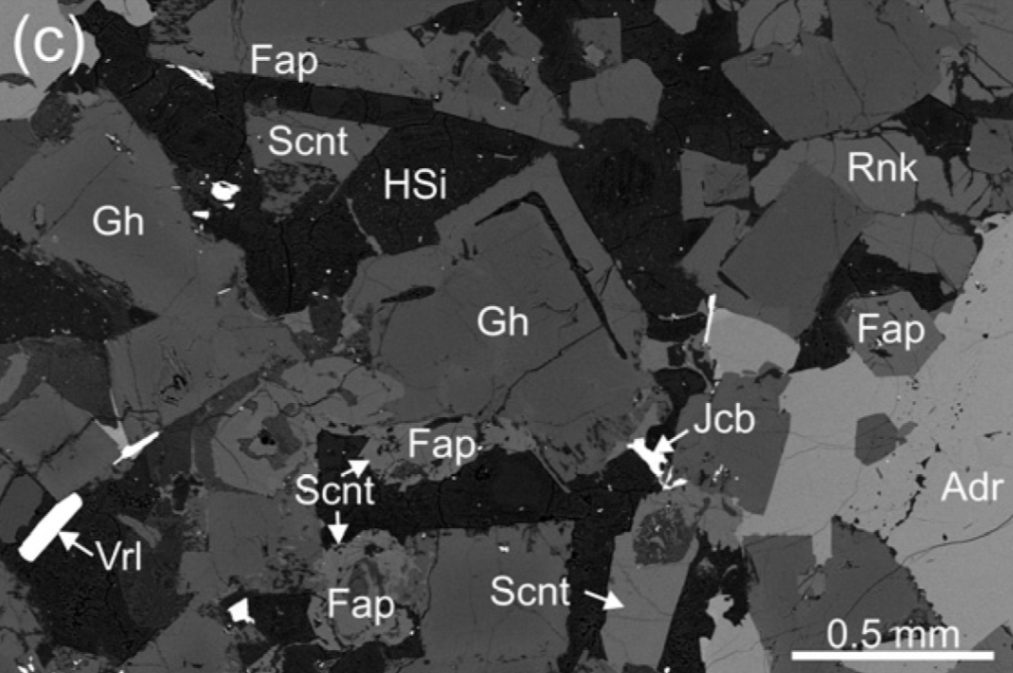
(a) Polished sample with gehlenite–andradite–pseudowollastonite paralava in hornfels. Hornfels––the dark part represents weakly altered gehlenite–flamite rock, the light part altered hornfels in which flamite is replaced by silicocarnotite and Ca-hydroxides, and gehlenite by hydrogarnet. In the paralava, the minerals are coloured as follows: Ti-bearing andradite––dark brown, gehlenite––light brown, wollastonite, flamite and pseudowollastonite––white. (b) A polished thin-section from the central part of the sample is shown in Figure 1a. (c) Silicocarnotite forms single crystals and rims on fluorapatite crystals. A crystal of V-bearing silicocarnotite is marked in the lower part of the image. (d) U-bearing pseudowollastonite, vorlanite and aradite aggregate in a large pseudowollastonite grain. (e) Reaction zone of rankinite between flamite and pseudowollastonite. Ara = aradite, Adr = andradite, Fmt = flamite, Fap = fluorapatite HSi = Ca-hydrosilicate, Gh = gehlenite, Jcb = jacobsite, Pwo = pseudowollastonite, Rnk = rankinite, Scnt = silicocarnotite, Vrl = vorlanite. — Photo: Galuskin, E.V.; Galuskina, I.O.; Książek, M.; Kusz, J.; Vapnik, Y.; Zieliński, G. · CC BY 4.0
Silicocarnotite
Silicocarnotite is an IMA-recognized mineral species in the silicate class, with the chemical formula Ca₅[(PO₄)(SiO₄)](PO₄).
It crystallizes in the orthorhombic crystal system (space group Pnma).
Key properties: Mohs hardness 5; specific gravity 3.06; White streak; Vitreous luster; optically biaxial.
IMA symbol Scnt, IMA status: approved, named in 2013.
Found in pyrometamorphic gehlenite-bearing rocks, likely the result of combustion of bitumen contained in sedimentary rocks, as a result of reactions between primary pyrometamorphic minerals (larnite, flamite.
It is found associated with Andradite, fluorapatite, rankinite, pseudowollastonite, kalsilite, magnesioferrite- jacobsite, and as lamellae intergrowths with larnite and flamite.
Adopts the long-established name for synthetic Ca5(PO4)2(SiO4).