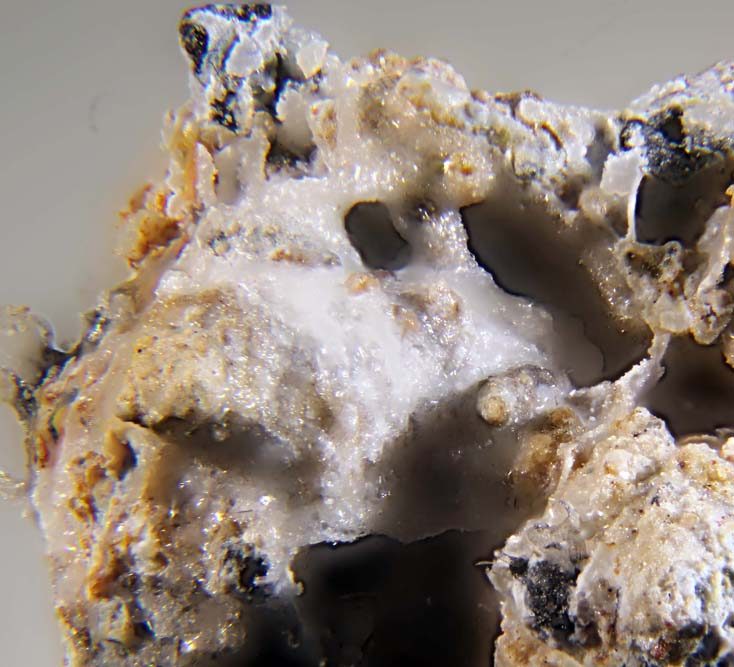
Simonkolleite is a very rare zinc chloride hydroxide known from a few localities worldwide. It occurs in this specimen as druses of white microcrystals. From: Richelsdorf, Hesse, Germany. — Photo: David Hospital · CC BY-SA 4.0
Simonkolleite
Zinc chloride hydroxide monohydrate or more accurately pentazinc dichloride octahydroxide monohydrate is a zinc hydroxy compound with chemical formula Zn5(OH)8Cl2·H2O. It is often referred to as tetrabasic zinc chloride (TBZC), basic zinc chloride, zinc hydroxychloride, or zinc oxychloride. It is a colorless crystalline solid insoluble in water. Its naturally occurring form, simonkolleite, has been shown to be a desirable nutritional supplement for animals.
Intro adapted from Wikipedia (CC BY-SA).
Simonkolleite is an IMA-recognized mineral species in the halide class, with the chemical formula Zn₅(OH)₈Cl₂·H₂O.
It crystallizes in the hexagonal crystal system (space group R-3m).
Key properties: Mohs hardness 5; specific gravity 3.292; White streak; Vitreous luster; optically uniaxial.
IMA symbol Skl, IMA status: approved, named in 1983.
A rare secondary mineral formed by weathering of zinc-bearing slag.
It is found associated with Wiilfingite, hydrocerussite, diaboleite, zincite, hydrozincite, zinc.
The mineral was named to honor Werner Simon and Kurt Kolle, mineral collectors of Cornberg, near Richelsdorf, Germany.