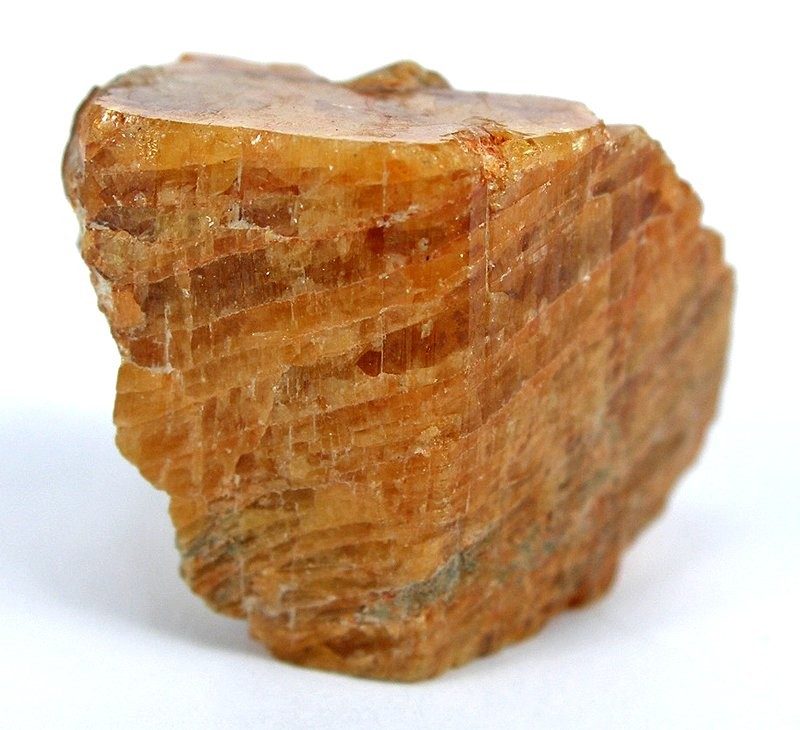
Simpsonite Locality: Alto do Giz pegmatite, Equador , Borborema mineral province, Rio Grande do Norte , Northeast Region, Brazil ( Locality at mindat.org ) Size: 1.6 x 1.5 x 1.8 cm. A sharp, lustrous, richly colored crystal that is doubly-terminated on top and bottom, though contacted on back. This piece was brought up from Brazil by Fred Pough in the 1940s when he made a famous find here (published 1945). He sold it in the late 1940's to Alex Mann of NYC. — Photo: Robert M. Lavinsky · CC BY-SA 3.0
Simpsonite
An aluminium tantalate-niobate forming high-relief tabular crystals in pegmatites.
Intro adapted from Wikipedia (CC BY-SA).
Simpsonite is an IMA-recognized mineral species in the oxides & hydroxide class, with the chemical formula Al₄Ta₃O₁₃(OH).
It crystallizes in the hexagonal crystal system (space group P3).
Key properties: Mohs hardness 7.5; specific gravity 6.68–6.82; White streak; Adamantine luster; refractive index 2.035; optically uniaxial.
IMA symbol Spn, grandfathered status — known before the IMA’s founding, named in 1938.
Occurs as an uncommon accessory mineral in some tantalum-rich granite pegmatites.
It is found associated with Tantalite, manganotantalite, microlite, tapiolite, beryl, spodumene, montebrasite, pollucite, petalite, eucryptite, tourmaline, muscovite, quartz.
The mineral was named to honor Dr. Edward Sydney Simpson (1875–1939), Western Australian government mineralogist and mineral analyst.